Brief History of Metal Detectors and Our Hobby
Pages 5–9
What is a Metal Detector?
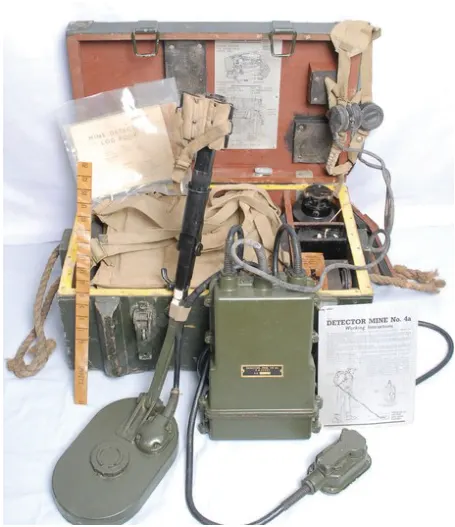
A metal detector emits an electromagnetic field from its search coil. When a metal object enters this field it causes a change or distortion. This is relayed to the control box, which analyses the response and provides a sound in the operator’s headphones and, on some models, a display on a screen. The strength and type of the signal can also tell the detector how deep the item is, and the type of metal it is made from. This information can also be displayed on some detectors. One of the first detectors was built by an engineer by the name of Gerhard Fisher. In the late 1920s he was working on radio direction finding equipment for aircraft and found that metal ore in the ground, or metal roofs on buildings, affected the system. From this early beginning he designed a metal detector, for which he received a patent in 1937. These very early machines were also used by geologists, gas and electricity companies, and the police. During the Second World War and afterwards they also helped to clear enemy minefields. These early mine detectors were heavy and used a lot of power, but they were the cutting edge of technology at the time. Lt. Jozef Kozacki designed the first practical electronic mine detector, called the “Mine Detector Polish Mark 1”. It was soon improved upon and mass produced. Some 500 were issued to the British Army in time for use prior to the Battle of El Alamein in October 1942. An example is shown here (reproduced with permission). It looks quite familiar to a 21st century detectorist!
After the war these very early machines were used at the very start of our hobby, although in those days you needed a partner just to carry the battery pack! It was in the 1950s and 1960s, with the invention of the transistor, that detectors transformed into lighter machines which used batteries that could be fitted integrally. In America, Charles Garrett obtained a patent for a “Beat Frequency Oscillator” type metal detector and this is when the hobby really started up, with more and more manufacturers coming into the market. Garrett was joined in the 1960s by other now well-known names such as White’s and Fisher. Shown above right is the first detector I ever purchased in the late 1960s. As you can see, it’s just a hoop on a stick with an adapted transistor radio; but it still works (after a fashion!). It is tuned by using the slider on the main stem. I was assured, by the shop assistant that I would find lots of things with it! After a couple of outings in the garden it went into the cupboard, and has seen many more cupboards since then. I now bring it out as a curiosity when giving talks! Tesoro, who started in the late 70s, became one of the early makers of a full range of machines. One of these models was the legendary, Silver Sabre, renowned for its ability to find small hammered coins. Tesoro, which is Spanish for treasure, are still going and I still use my Laser B1 as a backup machine. Great strides at that time were also being made in improving coil design, important for depth and signal recognition. Induction Balance machines gave the opportunity to discriminate between metals and ignore the targets you did not want (iron). So with the ability to read the type of metal found, machines were getting more sophisticated. Also, with further improvements in discrimination, they were going forward in leaps and bounds. One of the main bugbears of the early detectors was the effect on them of minerals in the ground. Reducing the effects of this mineralisation was one of the next big advances. However,

manufacturers had to be careful in the design of this “ground balance” as some metals give similar readings to ground minerals, and if the facility is wrongly set some desirable objects could be lost and the detector suffer from loss of sensitivity. Many new designs of coils came out in the mid to late 1970s, and this led to the development of “motion detectors”. With these, by keeping the coil moving, the detector could discriminate and at the same time auto tune out the effects of ground mineralisation. By the 1980s and 1990s computer technology was incorporated into detector design, and this had a fantastic effect on the models available. So we move into the late 1990s and the 21st century. What fantastic advances there were! Technology was advancing very quickly and giving us machines that were never dreamt of years ago. Many of the old names - such as Garrett, White’s, Fisher, and Tesoro - are still producing excellent machines. However, they have been joined by others - notably Minelab that started in 1985 but now, in our view, produces some of the most advanced detectors available. It was the Minelab Explorer II that found the Frome Hoard! The National Council for Metal Detecting (NCMD) was formed in 1981 in the dark days when most academics (archaeologists, museum curators etc.) did not get on with us, nor we with them. The archaeological community saw detectorists as little more

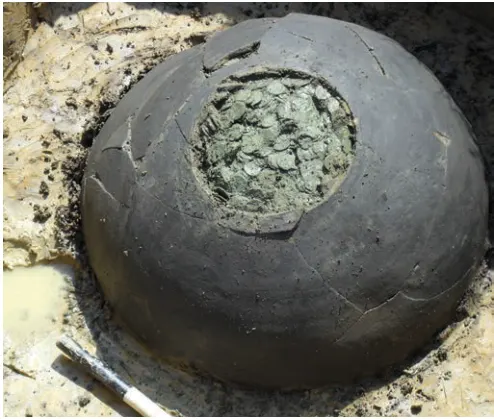
than thieves, raiding important sites and destroying information. The detectorists saw the archaeologists as arrogant and untrustworthy, trying to keep the past to themselves. There were even moves to make the hobby illegal. Yet there were small pockets of enlightened people and individuals who recognised, early on, that we could provide a lot of information from objects we found that were not being recorded. So although most of the academics, working in museums, would have nothing to do with detectorists slowly, in some places, the views began to change. The NCMD worked tirelessly to put across a reasoned and balanced view and argued that we should all be working together, for everyone’s benefit. Some metal detectorists and museum curators realised that it was indeed possible to work together and to respect one another’s views. One of the first places this happened was in Norfolk where archaeologist Tony Gregory (sadly now passed on) helped to improve relations and keep the dialogue going. The NCMD were actively involved in the shaping of the 1996 Treasure Act (which came into force in 1997), and they are still democratically elected to represent the hobby. The NCMD have always had a code of conduct that members keep to, and in the back of the book is a copy that has been agreed by all the main parties involved. Trevor Austin, who is presently the Chairman, even sits on the Treasure Valuation Committee, which independently values items of Treasure. In my opinion, we would not have this great hobby today if it had not been for the National Council; with this organisation hobby metal detecting could have been banned or severely restricted. Today we therefore have a hobby which is stronger, and attracts more interest from beginners, than ever before. The relationship between academics and detectorists has been transformed; indeed often the younger generation, on both sides, have no idea there was ever a problem. Below is an example of today’s cooperation between metal detectorists, museums, archaeologists, and the Portable Antiquities Scheme.
Coins on the PAS Database
All the objects recorded by the staff of the Scheme are published on an online database, finds.org.uk, which (at the time of writing) contains records of some 725,000 objects, although this grows monthly. We also encourage finders with the right
knowledge to record their finds on the database themselves. This unique resource does not exist anywhere else in the world and since 2003 around 18 000 people have volunteered finds for recording and/or participated in archaeological excavation/survey and finds recording. PAS data has increased the number of known Roman sites in Warwickshire and Worcestershire by over 30%, and more than doubled the number of known archaeological sites in Lincolnshire. Of the 725,000 objects recorded by the scheme (at the time of writing), around 271 000 are coins. They break down as follows:
| Coin group | Records | Note |
|---|---|---|
| Iron Age | 42,361 | Incorporating much of the Celtic Coin Index |
| Roman | 174,662 | Incorporating Welsh data |
| Greek and Roman Provincial | 172 | |
| Byzantine | 97 | |
| Early Medieval | 2,443 | |
| Medieval | 29,198 | |
| Post-Medieval | 24,100 | |
| Modern | 216 | |
| Foreign | 119 | |
| Unspecified | 398 | |
| Total | 271,066 |
(Data provided by Roger Bland and Sam Moorhead of the British Museum.)