14. Not One Hoard, But Two!
Pages 138–172

This is my story of the Frome Hoard; why I was there; how the excavation happened over three days; the many people involved in the last eighteen months; the coins themselves; the emperors; and how it has all changed my life. Metal detecting is my hobby but since the find I have met quite a few archaeologists and academics and, on the whole, I have got on well with them. So why did I find this hoard? Why did it then capture the imagination of people across the world? Why did the publicity carry on for as long as it has? I am going to try to explain what I know happened in 2010 and what I think happened in the Roman period at the time of the pot’s burial. I hope you enjoy
reading about my discovery of the largest single hoard of Roman coins ever! I have been detecting seriously since 1982 when I needed a hobby to help me relax: my wife reminded me that I had tried metal detecting once before, and suggested I try it again. I bought myself a basic metal detector and started, slowly, to learn about using it. I only changed my machine when I had mastered that one, and then only for a better one. One of the first things I did was to join one of the organisations; but that one did not sit well with me and I left. Instead I joined a small local club which, the next year, became part of the Western Federation of the National Council Metal Detecting. I am still in the Trowbridge club, and we are still in the Western Region of the NCMD. Our club members are a good mix of young and old and a better set of like-minded people you could not wish to meet. I am very lucky to have 10 farms where I have the trust of the landowners to detect whenever I like, and our Trowbridge club land on top of that. What more could a metal detectorist want?
Just Another Day Detecting
It was a sunny warm day in April 2010 that changed my life. I had a day off, from my job as a hospital chef, down here in the West Country, and I decided to go out for a day’s detecting. Arriving at one of my farms down in Somerset bright and early (well, about 10am - when you have all day there’s no point in rushing about!) I parked up on top of the hill and I could see that one of the far fields that the farmer had ploughed was ready for seeding. That’s the one for today, I thought. Ploughed and rolled is as good as it gets, so after kitting up, and checking the batteries on my Minelab detector, I started to cut across the two grass fields detecting as I went. One of these fields had yielded a siliqua in 2009 and an odd broken Hadrian a

bit before that; but nothing else - not a bronze coin of any sort, or any artefact at all. Coming into the second fi eld I got a sharp clear signal and, on my Explorer II, that normally means a good fi nd.
The First Siliqua
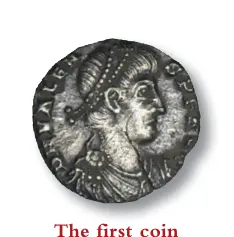
After digging down 2 inches there, in my hand, was a silver Roman siliqua! This was a beautiful late 4th century coin (Valens AD 364-78). It had a small crack in it and a little clipping, but was still a fantastic fi nd. I was out by myself that day, as Tony was working, so I tried to send him a photo on my phone just to wind him up. Unfortunately, it wouldn’t send! As stated earlier I had found a siliqua the year before, but this was recovered a lot further up the fi eld. I now had a second, but without giving it much thought I went on detecting. I had only walked about 2 feet, and then bang, I had another. That really stopped me in my tracks! I now had three silver Roman coins all of the same type, siliquae, and all approximately the same date. This could only mean one of two things: a purse loss, or a scattered hoard. This really started my heart pumping, and in the next few hours I found about 20 similar Roman coins, each giving me a good signal even though some of them were 7-8 inches down. Mixed in with them were a few broken bits, some only quarters, but giving very quiet although clear signals. By the end of that day I found about 30 coins in total including the bits. This was the best day’s detecting I had ever had! For somebody who is into Roman, this was the pinnacle of my detecting years. You can’t get much better than a scattered hoard of Roman silver coins! Or so I thought. Later on that day, before I went home, I stopped and showed my fi nds to the farmer, Geoff, who was doing the milking at the time. I reminded him that I had to report them to the Coroner, as they would certainly come under the new Treasure law. He was very pleased and interested as they were nice looking silver Roman coins, and he has always been attracted to the history of the farm. But he wasn’t as pleased as I was and, of course, he had to get back to the cows and the milking. Later that evening I got in touch with Katie Hinds, Wiltshire’s FLO who records all my fi nds. I just told her I had found a few Roman silver coins, and I would bring them in for recording at the next meeting, and I had already informed the Somerset Coroner by letter. That evening as soon as I had done all this I sent Tony an

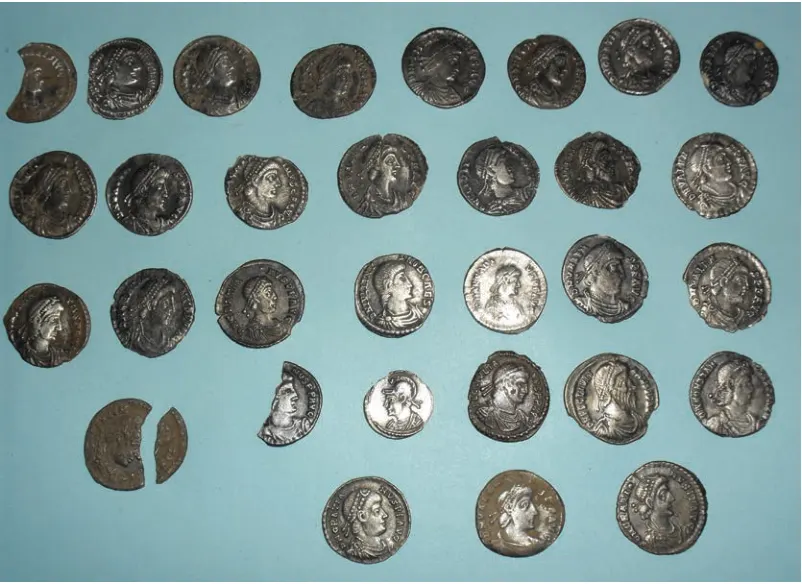
e-mail of one of the coins just to wind him up a bit. He e-mailed, back “nice coin”, and a few extra choice words. I replied back “Sorry, I forgot to say I found 30.” The phone rang within less than a minute! I think he was pleased for me, but I didn’t know some of the big words he used! Later the next week I went back again, and found another 20 odd coins. But by now the only signals were very faint, from just a few deep broken coins, and although the Explorer was still giving a good response, I was getting further away from the area of the main hoard. In the middle of this area, however, I did find a rather nice little bronze piece of twisted wire; at one this had been thickly gold plated and looks like a child’s bracelet. This might turn out to be medieval, but you know experts: you get two who say yes, and two more will say no, and another will sit on the fence. Eventually this was returned to me by the present Somerset FLO unrecorded, as it was deemed to be “just a bit of wire”. Personally, given it is two twists of bronze wire, carefully

The Day That Changed My Life
On the third day I returned, still searching the rough area where most of the coins had come from, but by now I had moved about 100 metres away from the main find spot. It was midmorning and I was finding very little, just a couple of broken bits when I had a funny signal. It was very faint, and not very clear; my display was jumping around and not locking on at all. Now the Explorer II is a really great machine but, like all detectors, it can be fooled by deep iron, and that’s just what I thought it was. But after 22 years of detecting I just had to check it out. I carefully cut my normal hole, about 7 inches square, and flapped it back on its uncut side. There was nothing in the divot, and no increase in sound. Six inches down in this small hole there was still nothing, and after another spadeful of soil and a further six inches, still nothing. It was time to get out my small probe, which is ideal for when you cannot find the target; but there was no signal from it either. By this time I was convinced that it was a bit of deep iron, and I was cursing iron, large horseshoes, ploughshares, and blacksmiths in general. I took yet another spadeful and there was still nothing in the spoil heap except a few bits of clay, showing I was well into the subsoil. I therefore got down on my knees and tried the probe again. At last there was a slight signal, showing that my find only 2 inches away at the most. It was time for the gentle approach, and out came my knife. I gently prized up a large chunk of the thick yellow clay and found just a small piece of black pottery stuck to it - but no metal. I could see that this was a piece of Roman black burnished ware pottery, but this is nothing unusual as there are always bits in any field that’s near a Roman road. I tried again and gently pulled out another handful of the sticky clay. As I turned it over, there, stuck to it, was one very small Roman “grot” coin. Green and grotty yes, but it was still a Roman coin, a small radiate. I was down a long way for a single small Roman coin to give a signal, so I pulled out another handful of clay; stuck on this piece were about 10 more of these small bronze radiate coins, and a few more bits of pottery!
Bronze bracelet or is it just a bit of wire?
It was at this point that I realised I had found another Roman hoard, and I just sat back on my heels and shouted, “I’ve done it again!” In over 28 years of detecting I had just found two hoards in three detecting days! I quickly realised that this was obviously a pot of coins that hadn’t seen the light of day for at least 1700 years, and was so deep that it hadn’t been touched by a plough. It must be completely intact, except for the broken black top, as the clay above it had not been disturbed!

A Day To Remember
“Well that’s a turn up for the book!” I thought, “But what do I do now?” My first instinct was to dig further, but common sense prevailed. I knew the academics (archaeologists, historians and coin experts) would wet themselves just thinking about a coin hoard in situ (“still in the ground” to you and me!). Also, as a club we always strongly encourage our members to record finds with the PAS (Portable Antiquities Scheme), so how could I, as Secretary, not do the same? It was a struggle as I had visions of dozens of metal detectorists stumbling over my hole while I was away. They always say that gold sends people funny, and I think my pot of bronze coins did this for me for a few minutes that day. Then I calmed down and started to think clearly. I was in the middle of nowhere; the pot has been there for about 1,800 years; only the farmer was going to know about it, and nobody else would know exactly where it was. What was the chance of somebody else finding it again in the next few days? However, it was one of the hardest decisions I have ever made. I did not know exactly what I had found; it could have been the size of a small beer pot with a few hundred coins or something larger.
Reporting Treasure
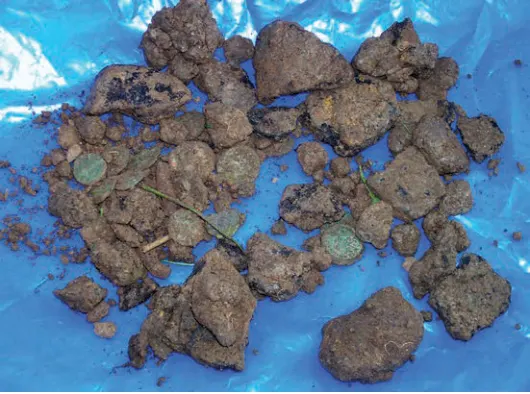
Before I went home, I went again to see my farmer friend Geoff to let him know what I had found. I had to pull him out of his cowshed again (he must live in there) and I showed him the few bits of black burnished ware, and the Roman grots, which were still mixed in with the clay. He wasn’t very impressed as, let’s face it, they didn’t stack up to the silver siliquae that he had seen a few days before. “But there’s a pot of them!” I explained, and he seemed more impressed at that, as he was always interested in the local history, and what sort of people lived on the land before him. So before he went back to his cows, he agreed to calling in the archaeologists and to let them dig up whatever was there.
Alan taking his first shovelful, while I stand by looking bored.
Here in Wiltshire, in our club, we work closely with our Finds Liaison Officer, Katie Hinds. Katie comes along to ever other one of our meetings to record our finds. So I gave her a ring to let her know that I had found a few more of the siliquae and, when she had calmed down, I just dropped it into the conversation that I had also found a pot with Roman coins, and they appeared to be radiates. I also told her that I had left it in the ground, and would somebody like to come along and dig it up? She was very excited about my news, and said she would have to inform the Somerset FLO, Anna Booth, about what I had found, due to it being in Somerset. At the same time I again informed the local coroner of the new events, as the Treasure Act requires.

I had seen a few archaeologists on the telly and had seen how they always seem to push detectorists into the background, if they allowed them to get a look in at all, and only very occasionally credit us with finds. I was determined not to be sidelined, so I gave Katie the dates that I would be available, as I realised they could do nothing without me! When she got back to me she had arranged for the pot to be excavated on my day off from work, just over a week later. We never dreamt at this point that it was going to take three days of digging. They arranged for an archaeologist to meet us at the site on the Thursday at 8 o’clock. I was a little apprehensive about this as I had never really met one, just seen some on television. I should not have been so cautious as, on the day, Bob Croft of Somerset Council had hired a private archaeologist (Alan Graham) to do the work, and he turned out to be a really pleasant bloke who knew his job well, and didn’t at all come across with a high-handed attitude. He was assisted on that day by the two FLOs - Katie Hinds and Anna Booth from Somerset. I had never met Anna before but she turned out to be a very pleasant lady.

That First Day
The Thursday turned out to be another clear and sunny day, which was really lucky, for I cannot imagine what would have happened if it had been raining. So initially it was Katie, Anna, Aaron (my grandson), Alan Graham and I involved. I showed them the radiates and the pieces of pottery that I had recovered, and they agreed with my assessment that it was black burnished ware. It was also pointed out that they looked like bits of the base of a small dish and this turned out to be quite relevant! After the introductions we walked across the field to the area of the find, and I filled them in as to what had happened with the siliquae on the last few days, and how I had found those coins. It was very
hard to see where I had dug, so I let them walk over it and then called them back. This was a great relief to me, as obviously the hordes of people digging up my pot never materialised! I had let them walk right over the spot just to show how well it was concealed. Pulling up the sod of grass I revealed the spot. Alan quickly formulated a plan to clear a standardised hole (a 1.5 metre square of grass and soil which was about 20cm deep). This entailed cutting and lifting the grass sods, and stacking them for later. Next, he started to clear the soil to reveal the yellow clay; all this took a bit of time as Alan was working carefully. As soon as he could see the clay he started to brush and scrape until all the dirt was gone; then the clay was completely clear of soil with just a few rocks sticking through. This showed clearly where my small hole went through the clay. The first thing he uncovered was the large horseshoe (my antidetecting device!). You can also see, in the photo, a circle of yellow clay showing the disturbed ground where the Romans dug the original hole. Next, Alan put a line across to section my small refilled hole - cutting it in half from corner to corner - and proceeded to carefully clear away the soil on one side. This was a very slow process, as the clay was thick and hard, and Alan was doing the job very carefully. This slowly revealed half of a rim of an upside down broken


black dish; this is where my bits of black burnished ware came from. This showed the dish, which some people call “dog dishes”, as that is what they look like. It was evident that the dish was a form of lid as there was something else underneath. This turned out to be a rim of a container and this is where I had got my few radiates from. Through the bits of broken pottery we could see a few coins, but they were all covered in thick muck from the soil and clay so, in 1700 years, not one had been lost into the soil! Watching him slowly uncovering the top of the pot as it just got bigger and bigger, the excitement was infectious as we realised how big the vessel was getting. We still could only see the neck, but it seemed to be getting the two FLOs very excited. Then as Alan carefully worked the clay from around the neck, the pot itself started to appear; this also was a lovely very dark blue, nearly black, piece of pottery that was obviously a completely different type of ware from the “dog dish”. Where Alan had started to clean away the clay there appeared a glistening jet black pot that just started to get bigger and bigger. Once he had taken the clay down a bit more, the talking started about how big it was going to get. During all of this time we were taking photos from every angle; there must have been hundreds taken in that Somerset field before we had finished. By now we had gained a considerable number of onlookers, mostly the family of the farm owners, and everybody was interested to see what the pot was like. The excitement steadily grew! Soon phone calls were being made to the British Museum (BM), in London, and to Somerset County Archaeologist Bob Croft to let him know that the pot was getting bigger by the minute and could be as big as the Cunetio pot. The Cunetio Hoard was dug up in an old Roman town (Cunetio) just outside of Marlborough, Wiltshire, in the late 1970s. This hoard contained nearly 55,000 coins but that one was in two containers. The finders just dug them up and took them home, and

then proceeded to mix all the coins together losing lots of information. The main pot survived, but the second lead container was thrown away before the archaeologists could record it. One call by Katie had museum staff in the Wiltshire Heritage Museum in Devizes measuring the Cunetio pot, which was on display after it had been put back together. This was just to check how the pots compared in size, and from what could be seen they were very similar. After a call from Anna, Bob Croft (Somerset County Archaeologist) arrived on site to find out for himself what all the fuss was about. Alan was still slowly working his way down the top of the pot rim to reveal the walls as they slowly curved outwards and, as he cleared away the clay, a beautiful glossy black wall appeared. It was cracked, into very large pieces, but it still held together just as it was put there all that time ago. This was still the first day and he was, even now, only just working on the other side of the top half of the vessel. From the very beginning photos were taken from all sides to record every aspect of the excavation and Alan was also drawing a detailed diagram as he went down. After Roger Bland, Head of the Portable Antiques Scheme, and Sam Moorhead (Roman Finds advisor) had phoned and asked about the chances of removing the pot whole, it was decided that this was not possible and the coins would have to be removed systematically. It was now late afternoon and it was obvious that the excavation would continue into a second day, Friday.

Night Guards
It had been fairly obvious later in the day that we would not be finished by nightfall so, after a few phone calls, I arranged cover for my job on the Friday and also for camping equipment to be brought out so that Aaron and I could sleep next to the hole overnight. The pot was covered up with sacking and bubble wrap and everybody else left for the night. The farmer’s family stayed on for a while and then left us to it At this point, when it was starting to get dark, it left just Aaron and I with a fantastic pot that had been there since Roman times. Camping in a field in Somerset, with the shadows from the moon

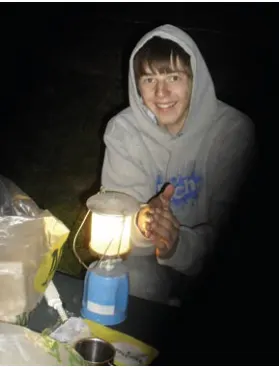
creating a spooky atmosphere, and with the noises of the night all around us, the reality of it all started to sink in. But even then I had no notion of what was to come! We started to get things organised for the night. There was no way we could stay awake as we were both knackered; it had been a really long day, and there would be another one tomorrow. So after a snack and a hot drink, we just turned in, hoping that I would wake if anybody came into the field. I think those Roman gods were still looking after their pot, as we both got a good night’s sleep.
Friday
The next day I was awake at 6am just as it was getting light. Therefore after putting the kettle on and getting dressed, I started to do a little detecting! Aaron, like all youngsters, could sleep for England, and only just got up before the team arrived at 8 o’clock for another day’s dig. As soon as they were okay (they didn’t really need us) Aaron and I went off to the local café and had a good breakfast. All that fresh air gives you a good appetite! Alan started by removing the small black dish that was acting as a lid. With it came a few of the loose coins that the dish had been covering. This left

the rim of the pot completely exposed; you could see that the large pot was full to the brim with more coins! This left a nice clear, clean area to work on, and using the same string mark as a guide, Alan started to systematically remove the coins. The idea was that he would remove a layer at a time, each containing about 600 coins with all the muck attached to them, and put them into a numbered bag. Alan slowly worked his way down the first half still using the string, which was placed across the top as a guide.
Better Than Mushrooms
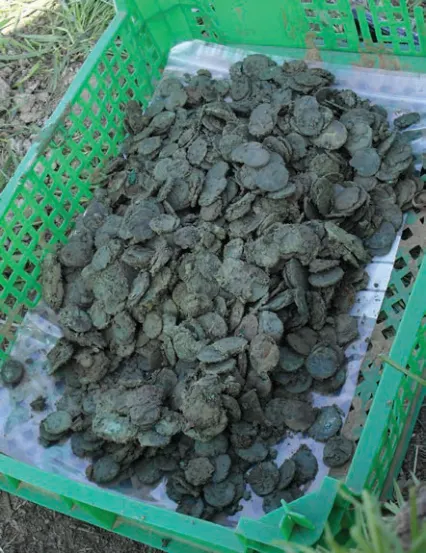
This was a slow but meticulous way of doing it, and it seemed to take forever! Alan removed the coins into a mushroom box that had been lined with plastic and one of us scooped them up and placed each box full into the numbered bags. Our hands turned green from the colour that was in the mud that surrounded the coins. This was not a good time for eating your sandwiches! By that evening only the bottom half of the pot was left to remove. Alan was very particular and, at one stage, could not find a missing piece of pottery. Now this piece was about 2 inches long and about 1 inch wide; not a very big piece, but still important. We could see where this small piece should have been, but we could not figure out where it had disappeared to. Alan then had us carefully sifting the soil and running our fingers through the piles of clay fill that had been cut away from around the pot. We still could not find it. Alan was really concerned to think that we had lost it and, after we all had looked for at least an hour, one bright person pointed out that there was a small space just inside the pot, and it could have slipped down inside! And that is where it was. Alan was so pleased to think that it hadn’t gone missing! Seeing the coins coming out over a three day period was fantastic. They were all covered in thick green gunk, and you had a hard
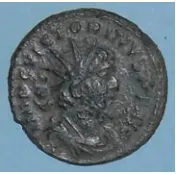
job to tell what type of coins they were, but it was fairly obvious that the majority of them were going to be bronze radiates. Radiates are Roman coins, with the name coming from the “spiked” headdress, or “crown”, that the emperor is wearing. These actually represent the rays are from the sun god, Sol, and imply a link between the emperor and the god. The example shown is of Victorinus, who ruled AD 269-71. Alan did such a professional job by taking the coins out in a methodical way that later, in the British Museum, they could tell just where in the pot any particular coins came from. This was essential for the recording, and in the later understanding of the hoard.


At each stage of the process photos were taken so a complete set of written and photographic records were available for studying at a later stage. Apart from my 150 odd photos, there were the FLOs taking their own images, other archaeologists, and visitors to the site; and, as if that were not enough, they even employed a professional photographer to come along and make an official record! This must have been the most photographed pot of coins ever found! By the end of day two, only about three quarters of the coins had been removed. Another night’s camping was called for and, as I could not get out of work on the Saturday, Alan kindly offered to sleep on site that Friday night. By the time I arrived on the Saturday, nearly all the coins had been removed and I saw the last few being taken out; this just then left the bottom half of the pot in the ground. Alan then started to
remove this last link with the Roman people who had lived and worked in this place we now call Somerset. Slowly and cautiously he removed each piece, which was then laid on some bubble wrap in another mushroom tray, and carefully packed them away. As much care was taken with this pottery as with the coins themselves. This produced, at the end of it all, 67 bags of coins, which weighed in at 160 kg which is about the weight of two adults!
A Roman Hole
It was a funny sort of moment as there were so many people there: archaeologists, FLOs, museum services, the landowners, and two of my family; the visitors’ kids had been brought along as well! There was a bit of a carnival atmosphere, but at the same time it was all a bit sad. The coins had been removed and bagged, and now the hole where they, and their beautiful black pot, had rested for 1,700 years, was just a hole in the ground. The Romans had dug this hole about 4 feet long with one end nearly squared off and the rest in an oval shape. Alan followed the line of the original hole as he cleared away the clay to show what they had dug. The empty pot could have then been placed into the hole, and carefully packed with straw and grass around the sides to protect it. Then it was slowly backed-filled with the thick sticky yellow clay, to stop it falling over, until just the rim was left visible. They could then have started to fill this plain storage pot with coins. It must have taken many people to come forward and drop in their coins, maybe tipping them from satchels and panniers. Maybe some just had a few in a purse; maybe some had a sack-full, but they slowly filled the pot. The coins must have come right to the top, until there was no room for any more. They must have done this filling very carefully as we did not find any loose coins in the clay or dirt around the hole.
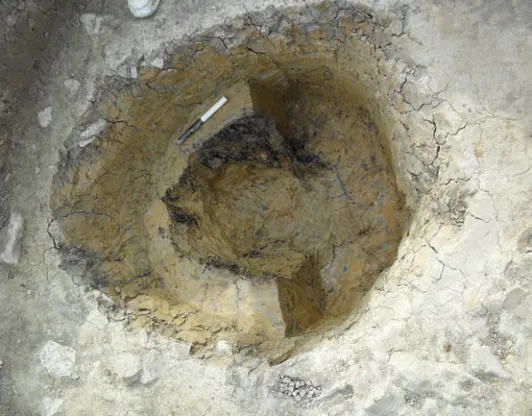
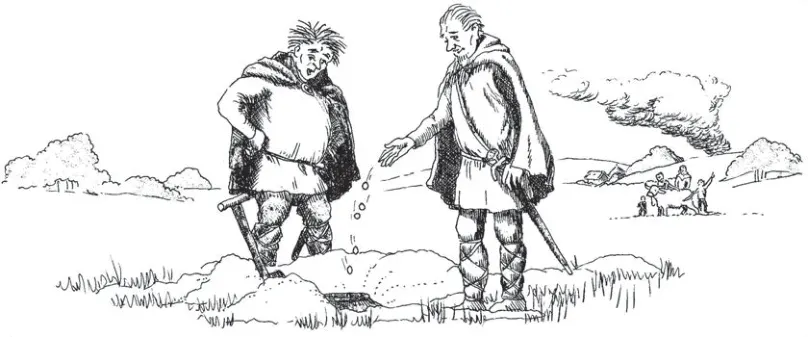
How many people did it take to give their savings? We just don’t know, but the experts are confident that it had to be a communal action. Once the pot was filled with coins, they used the upturned “dog dish” to make a lid, and this must have capped it off well. The hoarders then carefully placed more lumps of the yellow clay around the lid, to stop it slipping, before putting on a covering with more clay until it came level with the rest. This then would have left a hole 3 feet across and about 12 inches deep. It would then have been an easy matter to fill in the top soil that they would have kept separate. Then, by removing the pile of clay that had not gone back into the hole, no sign would have been left for anybody to know just what had been going on. Did all this happen at night, so nobody else knew about what they had just done, or were they just confident that nobody would touch it, because it was a gift for the gods? That, archaeology cannot tell us! Out of over 52,000 coins, only five were quality denarii silver coins - why? Were these coins from somebody who could afford that amount of money; were they making a point with their gods, or maybe just trying to impress the neighbours with their generosity? Or were the denarii just dropped in there by mistake, just a slip of the fingers! I cannot see any Roman asking if he can get his five coins back because they were too valuable!
The Surrounding Area
There is no known villa activity anywhere close to the site, and no indication at all of a settlement in the area. Where the hoard was
buried is close to where a Roman road crosses that part of Somerset, although its route is not known exactly. This was a major Roman artery from Salisbury in the east running to Charterhouse in the west. At the eastern end of this stretch of road was the Roman fort of Old Sarum (Sorviodunum), just outside modern Salisbury, which was an important encampment for the Romans. Charterhouse (Iscalis) was, in its own right, an important mineral resource area as it was a vital producer of lead, with silver as an important by-product. Salisbury was also a main road from London via Silchester which continued, via Dorchester, to the coast. This made the road a good way of transferring goods and people across the country. Just before reaching Charterhouse the road crossed the Fosse Way, another main Roman road, making this region a very accessible area to all travellers. There are many villas spread across this part of Somerset and Wiltshire, with many more yet to be found. There is also an important temple at Cold Kitchen Hill, on the road just by Maiden Bradley. So with all these factors, this gives us a well-used road passing close to the find spot. The people who passed on their travels included, primarily, the military forces that had the roads built for speedy communication and the movement of troops. In addition, there was the local and municipal administration - merchants with their wares, the postal system, and of course all the civilian population. This was a well-used and busy road.
Their Gods
The shape of this empty hole in 2010 told its own story; this was what the Somerset Romans had dug 1700 years ago to hide their offering for their gods. People in that time took their belief in the gods to the extreme; gods lived in the trees, the wind, the water, houses, and in the ground….in fact they had a god just about everywhere! It was a fundamental principle of their belief that if you made an offering, which could be coins, a brooch, a ring, a bracelet or just about anything that had value, then the gods would look favourably on the giver who would receive some benefit to themselves. This was their core pre-Christian belief. So by placing a valuable item into water, where it would disappear out of sight, the gods would accept the item, and would then help the giver with their problem. They even believed that writing a curse down against somebody else, and sending that with a gift, would bring hardship to that person. This belief in their gods and that they could, by giving gifts, alter
the natural world around them, seems to be the logical reason why the hoard was put there. They needed something in return; maybe they had had a few bad years with poor crops, or disease in their animals. Maybe they had experienced a few very dry years. Any of these would need a suitable offering. It would also seem logical that this vast amount of small change was not given by one person, but probably by a whole group or community, getting together to ask their gods for help. The amount of trouble that they went to in order to bury this gift, and the fact that nobody came back to retrieve it, shows how they felt about their beliefs. I just hope that they got what they wanted, and the gods gave them better weather or better crops the following year. Perhaps that next year, AD 294 or 295, was a good sunny and moist year; perhaps they grew a bumper crop of cabbages, and this was all their profit. I do hope so! There was another reason that suggests they were not coming back for the coins, and that was that they had used a very deep pot with a narrow neck. So if they had wanted to retrieve the coins at some stage they would have had to break the jar in the hole to get at all the coins, with a fair chance of losing some. Also to dig out the pot would have taken as much, if not more, work as it took to bury it in the first place and, at 160kg, it would have been too heavy to lift. Back to the present, it was then just a matter of me checking the hole to ensure there was nothing else buried there, or that any of the coins had been missed. Then everybody gave a hand to refill the hole and make good the grass turf. Before the hole was filled in I felt we should leave something as a token of respect for their beliefs so I threw in a handful of modern coins I had in my pocket, which included a couple of foreign ones saying, “That will flummox the archaeologists in a thousand years time!”

The British Museum

A day later, Roger and Sam came all the way down from London to collect the coins, and only just managed to get all of them into their car! So off they went, back to the British Museum, to allow basic conservation on the coins to be be carried out as soon as possible. This consisted of carefully washing the coins, one bag at a time, then drying them separately laid out on large trays, to ensure they didn’t stick together. It took about nine weeks, just to wash and stabilise them! They could then be counted, and sorted into different emperors. The coins in each numbered bag were washed, dried, sorted, and counted separately, to ensure they did not get mixed up. So even now they can fix any coin to a particular layer in a certain part of the pot, and understand how it relates to any other part of the hoard. This helped them to squeeze every last piece of information from the find. For this we can thank Pippa Pierce, metals conservator and the team at the British Museum for, without their expertise, we would not have ended up with so many well-preserved coins. Overall, some 400 hours have gone into the work on the coins so far, with a lot more to come. Roger and Sam counted and sorted the majority of the coins and many other unnamed PAS staff and colleagues also helped with this mammoth task. This is all a far cry from the 1978 Cunetio Hoard; those coins could not even be related to which container they came from! All the coins were just dug up and completely jumbled together. There was a large opened mouth pot and, apparently, a lead container and there was no attempt, at the time, by the detectorists to keep the coins separate. There was no thought about the knowledge that would be lost forever. So we cannot be sure which coins, and how many, were in each of the containers, or indeed how many coins were originally in the total hoard. When the archaeologists went back to the Cunetio hole and did an excavation they found more loose coins that had just been left lying around, and some even still in the hole. The amount of
information that was lost was immense. The finding of these two large hoards, separated by 33 years, show completely different ideas of how to correctly metal detect, and what you should do (and not do!) if you find something which is of real importance, and you just might!
Continuity
I am, and always will be, the finder of the Frome Hoard, but it has always belonged to the Romanised Somerset people. When this pot was buried, in AD 293/294, the Romans had been here for over 200 years in the form of military personnel, administrators, tradesmen, artisans, and civilians. All of these people, generations of Romans, intermingled with the local tribes. Some of them married native women, raising children, mixing the Roman and Celtic genes. The present people of Somerset are the descendants of those for whom the hoard was so important. So who better to have the responsibility of safeguarding the hoard for future generations? That is why I am very pleased that the hoard is “coming home” and is going to be on display in Somerset’s Taunton Museum where it will be on show for locals and visitors alike. Maybe a relative of one of those Romans will come and marvel at the display of these 3rd century coins, and the striking grey ware pot, not realising that maybe some of his or her ancestors had put it there!
All Finished?
So there it was: the coins had gone to the British Museum, the hole had been filled in, and everybody else had left the field, and then there was just me. It was a funny sort of feeling after everything that had gone on over the last three days. Now all I had to do was to close the gate and walk away - or so I thought. On Saturday I locked the gate and drove home, thinking that it was all over bar the shouting - but how wrong I was! It was not long before the Somerset FLO was in touch by e-mail and asking me about going public. This is the one thing I did not really want to do before the inquest, as I thought it, would be better if it all came out on the day. Of course, I really had no idea how big the media thing was going to get. It was just then that a few rumours started circulating, on a forum page, about a big find of Roman coins in Somerset, and it was evident that somebody in the know was leaking hints. The crunch came when before my Wiltshire FLO, Katie Hinds, had been told that the first count had been done (and it was approximately 52,500
coins), it was already on the internet “as over 52,000”. Somebody “in the know” in Somerset was passing on hints and starting a lot of speculation. I was lucky to have a friend who used the same forum, and he was able to play it all down. From then on nothing more emerged, so maybe the leaker had second thoughts. But at least nothing had got into the wider press; pillow talk is best left just there!
Geophysical Survey

It was about a week after the coins had gone that it was felt by the BM that a geophysical survey would be a good idea. My farmer friend was happy, as he wanted to know if there was any reason the coins were there, and I was happy for this to go ahead, as it would prove that there was no habitation in the immediate vicinity. You can often tell if a site has had any amount of habitation on it over a period of time as the soil changes its composition with all the added mineralisation. Every one of my good Roman sites starts to chatter when you cross the unseen edge. Sometimes you can see that the soil changes colour, and there is a marked difference with the amount of very small pottery shards; but on this site there was nothing like that at all. It was on the following Friday that a team came down from Bradford and, over the weekend, covered the whole area with their survey. So what did they find? Nothing! There were no foundations of a villa, or any other buildings, a ditch, or a road - there was nothing at all! There was not a single indication that the Romans had ever been there, apart from one large pot of coins and (100 years later) a scattered hoard of siliquae! I was pleased that I had been proved right, but still a little disappointed that nothing at all was found. Things for me went quiet then and all I could do was wait. Roger and Sam, from the BM were really good in keeping me up to date with what they were doing, which was sorting and counting the coins as fast as Pippa and the team cleaned and dried them.
Digging For Britain

Digging For Britain was a BBC series about archaeology, including some of the most recent important finds from metal detectorists. It was in late May when Roger Bland got in touch and said the BBC were making a pilot programme about Roman Britain for this new series, and would I like to be involved with the events surrounding the hoard? I said I would think about it, and I did, for about 10 seconds! Then it turned out the presenter was Dr. Alice Roberts, from the “Coast” (and much else), and that was an added bonus. It was a great few days as it gave me a chance to see how they put the programme together. Working with Alice, albeit in a very small way, was great and at the same time very interesting; being interviewed by her was fun as she has a good sense of humour. John, the producer, and his team were helpful throughout, and I was pleased with the results. Of course all this filming had to be kept quiet as well, as the BM wanted to make a controlled major announcement of the hoard.
Live TV
It was in July that the BM had sent the paperwork to inform the Coroner that an inquest would soon be needed for the two hoards, and from this point any attempt at secrecy went pear shaped. Early in April when I had written to the Coroner and informed him of the finds, I had asked for no publicity until the day of the inquest. This is one of the things that I believed you could request. It was in early July that I received a phone call that heralded the publicity explosion. I was told that the Coroner’s Office had just released a press statement that they were going to hold an inquest into a major Roman coin hoard. This also included my name (so much for asking for no publicity!). Within hours I was doing interviews for the evening news in my garden for the BBC and ITV. The first TV news I did was live, and I was talking to, and answering questions from, the news team in London, and being filmed in my garden. Isn’t technology great? That was a little nerve-racking, and I even managed to call a
Roman radiate a radial! It’s funny now but at the time I was cursing! The phone had started to ring and never seemed to stop. I went to work the next day but I never got much work done, or a moment’s peace, as my unfortunate wife at home had to answer the phone all day, and pass on my number as everybody seemed to want know about the hoard on live radio. If it wasn’t a local station somewhere in Great Britain, (and there’s plenty of them), it was Canadian, or Australian radio. These interviews went on for about three weeks, and in the end I must have done about 40!

Field Day For The Papers
The next day the papers had a field day as everybody across the world knew about the hoard at the same time. It’s a pity that they didn’t all check their facts about the valuation procedure, but perhaps they all made inflated guesses to sell newspapers. The independent valuation by the Treasure Valuation Committee was months away, but that did not stop them being “creative” with what they thought it was going to be worth, with the Daily Express coming up with a silly figure of £3.3 million. Then it was a case of continuing my work with more interviews and rushing in and out of local studios. When it made the headlines in Australia, one of my great nephews, Peter from Coffs Harbour, was the toast of his school when he was able to tell them he was related to me (poor soul!).
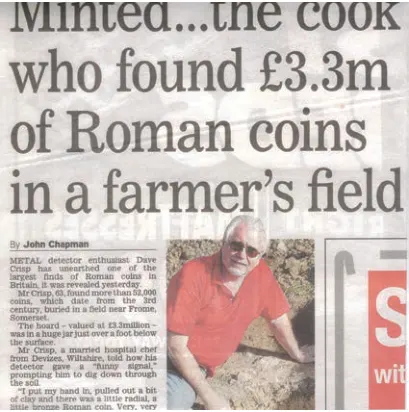
Where do they get their information?
The Inquest
The Coroner’s Inquest, which is a legal formality, was to be held in Frome with a public display of some of the coins in the afternoon.
This was the first time the public had an opportunity to see any of the coins and was being held in Frome Library. The day started for me as I arrived driving past the court house, and saw the outside was packed with reporters and camera crews. It was a good start as the car park was full, and there was no parking on the road I had to drive around the corner and walk all the way back and, as I had cut the time short, and got besieged by questions on arrival, I only just made it in time! The Coroner was nice chap and after he had heard Anna’s bit, he asked me to take the stand, and tell my story as to how I found the hoard. It was all very laid back, and I found it a good laugh and not at all intimidating. He asked all the right questions, thanked me for my evidence, and then summed up all that he had heard, including the written evidence from Roger Bland and Sam Moorhead of the British Museum. As expected, he ruled that the hoard was Treasure and this was the only way it could have gone, being the obvious decision. Outside it was quite chaotic as the journalists, and a couple of TV reporters, all wanted quotes and interviews. I managed to get away in the end, and drove down into the town to the library.
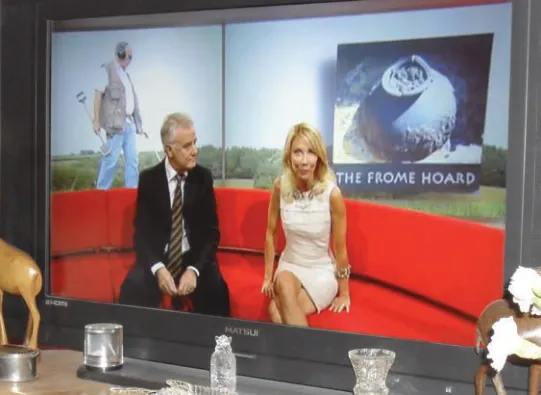
Frome Library
As I parked one of my farmer friends met me and told me to hurry as the waiting queue was out into the car park! Interested people had started to arrive when the library opened, and only Sam was there as it wasn’t supposed to start till lunchtime when we thought we would be finished with the inquest. The people who came that day were enthusiastic and patient, as the queue was not moving very fast; in fact it didn’t seem to be moving at all sometimes. I spent most of my time giving interviews, talking to people who were waiting in line, and explaining what I knew (very little then) about the coins. When I got home that night
I was knackered, but was still on a high; the interest and enjoyment that people showed that day was quite wonderful. That was an amazing day and some 2,000 people queued to see the coins. If you were one of them, I can only say thank you very much for coming, thank you for waiting in line, and I hope you thought it was worth the wait!

British Museum Display
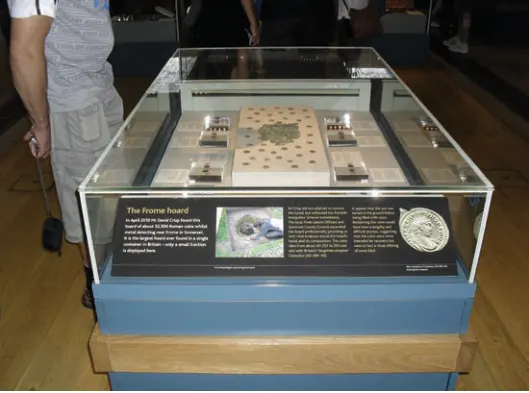
It was late July that I received a phone call from my brother, up north, saying congratulations - he had seen the great coin display in the BM. I didn’t even know there was one, but I quickly confirmed there was! My brother went on to say that he was very pleased for me, as I was the only person he knew of who had experienced a display in the British Museum, and wasn’t even dead! I think it was a compliment, so I took it as one! Later I travelled up to London just to see what it was like. He was right; it was a great display in the middle of the long Roman room. I could not have wished for a better display or a better position for it. I spent most of the day just standing there talking to people who stopped to admire the coins, and telling the story. I met a lot of good people that day, all interested and fascinated by the number of coins and the length of time they were in the ground.
Frome Hoard Book
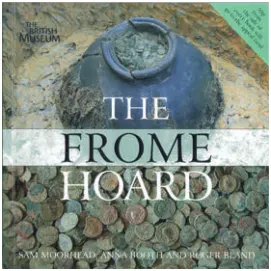
I was amazed when I first saw the book they had been written about the hoard. It was so well done: it told the basic story of the hoard, from the academic’s point of view, and was an excellent account. In such a small book it managed to convey the context of the coins and what was happening at that time. It was written by Roger Bland and Sam Moorhead of the British Museum; Anna Booth who was the Somerset FLO, was there in late 2010 when there was book launch in a Bath Art Gallery, which Ann and Geoff, the landowners, and I attended. The authors were there and the manager from the printers who had done such a good job, in a very short time. The book gives such a wonderful insight into the coins of Carausius, and the time scale of the Roman Occupation.
The Landowners
No book on metal detecting would be complete unless the landowners and farmers were fully complimented and thanked for giving permission to complete strangers (in most cases) to park, walk across, and dig holes on their land. It takes a very agreeable sort of person to allow us access to their farm. Ann and Geoff are two of these. I first knocked on their door in 2009 introducing myself as having permission to detect on their neighbour’s farm, and that I was sure that the Romans had been in the area. I then said could I metal detect on their land as well, please? They were both charming, and interested in the history of the area. They realised that a Roman road crossed their land, but had never seen anything that might indicate habitation. They both made me welcome, explaining they had given permission to a metal detectorist before, but nothing interesting had been shown to them. I assured them that they would be the first to know if I found anything. Little did we

guess what was to come, just over 12 months later! So from all metal detectorists everywhere, many thanks to all the farmers and landowners who give permission and a special thank you to Ann and Geoff, shown here at the book launch held in Bath in 2010.
Treasure Valuation Committee
This is where the price is put on the hoard, or any other Treasure item. After the Coroner has declared the item (the hoard in this case) Treasure, the TVC can then go ahead and value it. This board is completely independent, and is made up of experts from various fields. They come from a variety of professions and they even have a metal detectorist on it, who is Trevor Austin, the General Secretary of the NCMD. The committee asked two large auction houses to come in and put an estimated provisional valuation of what the hoard would fetch on the open market. They came to the BM on separate days and each valued the coins as to what they thought. A written valuation was received from each, but as they were so very different a third auction house was commissioned to do another. When this was received, the committee then used all three valuations as a basis to work from. The committee members take these valuations and proceed to give their views on them, giving reasons, and considering any recent sales on similar items. After a discussion they come to a compromise valuation that everyone is happy with. It is apparent that they take the valuations seriously, and I personally believe that they do a sensitive job very professionally. You are sent a provisional valuation letter before the committee sits, and it is at this stage you can comment on the estimate, and can still even have your own valuation done. Also, if you feel that there is not enough time for this you can request an adjournment to the next meeting. Indeed, I did

once, a few years ago, ask them to take into consideration some further evidence on the valuation of a single item I had found, and the outcome was very favourable. The Frome Hoard was valued at a total of £320,000, which was split 50/50 between the owner of the land and me. I was very pleased with this figure, as was the landowner, and I felt this was a fair valuation. It was actually more than I had estimated, but I did not have the specialised knowledge on the better quality coins that were mixed in with the rest, or the up-to-date prices that particular coins were getting in the auction houses. With nearly all Treasure items, they are first offered to a local museum to purchase. If they want the item for their display, they have to raise the cash by asking charitable institutions for donations or using their own reserves. For the purchase of the Frome Hoard we shall always be indebted to the three main contributors: The National Heritage Memorial Fund, The Victoria and Albert Purchase Fund, and the Art Fund. Donations were also received from smaller institutions and some very generous individuals.
The Coins
Let’s talk coins - all 52,503 of them! It was probably in AD 293 or early 294 that these sack loads of coins were deposited into the ground in modern Somerset. Why they were deposited, and why there, we shall talk about later. But we can make an educated guess as to when the coins were placed into the pot and buried, due to the type of coins. The latest coins are of Carausius and he was murdered in AD 293. So if there are no subsequent coins of any of his successors, then the chances are that it was buried late in 293, or very early in 294. The person who took over from Carausius, and made himself emperor, was another self-made man, Allectus (who was himself disposed of in 296 when Britain was taken back into the Roman fold).

This is relevant because there were no coins of Allectus or any of the future emperors in the hoard. All that said, there are also still 8,000 coins that need conservation before they can be identified, so as they are cleaned any of the numbers or the dates may yet change! Of the coins that we know so far, the vast majority of them are base metal silver radiates. Some are in better condition than others but the majority only have five percent (or less) of silver with the remainder being made up of various sorts of bronze. Some of the coins are just silver washed. Overall, the majority are in quite good condition, although the quality of some at the moment leaves a lot to be desired. It’s going to be a long slow process to conserve all the coins, as they have to be done by hand one at a time. This is all so they can be preserved for future generations to see and study. Well, as of now, we know that there are 20 emperors’ coins in the pot plus those of a few wives, and a couple deified after their deaths. The range covered is between Valerian (AD 253), and Carausius (AD 293), so 40 years. The most of any one emperor is Tetricus who ruled in the period AD 271-274. The next highest amount is those of Victorinus (AD 269-271) with about 7,500 coins. The least any emperor had to his name was Lacelian who had only four coins, but as he seems to have managed not quite a year in the top job, this short stay might have something to do with it! Carus’ wife did manage to get two into the pot, but Carus, himself only managed eight in his one year in the top job (AD 282-283). The ones of these that seemed to excite the academics most were the coins of Carausius, and there were nearly 800 of these and this raised a few eyebrows as it’s the highest number of his coins ever found in one place. (See Sam Moorhead’s piece on coin finds). The initial washing and drying has stabilised the condition, but it is going to take a year or more for two people to properly clean and conserve each coin individually. With this will come a greater knowledge of the coins, and what was going on in this period. With all these radiates there were just five coins that were truly exceptional. These were five silver denarii, in extraordinarily good condition. They did not appear to have any significant wear, suggesting that they were placed into the pot soon after they were minted. A denarii is a Roman silver coin that had been produced and used by the Romans from the early years of their civilisation, and 25 of them was worth one gold aureus coin. What made these coins exceptional was the fact they were minted in this country, and by the rebel emperor Carausius.
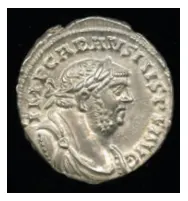
Carausius was apparently all of the above and more! He was born on the modern day Dutch/Belgium border, apparently of middle class parents. He joined the military and came up through the ranks, rising high enough to come to the attention of the emperor. He was then given a job as the commander of the Roman fleet in the channel to keep it free from Saxon and other raiders who were looting the coastal towns of Britannia, and threatening the grain and cargo ships that were crossing the channel for trade. After a while it was alleged that he found it more profitable to intercept the raiders after they had plundered the coastal regions, and then to keep the spoils for himself. This might have all been conjecture, but when Maximian recalled him back to Rome he knew his time was up, and that if he went he wasn’t coming back. So he had little choice but to declare himself Emperor of Britain and part of Gaul and take his chances. Now at first this appeared to go okay. After all, he had command of the fleet in the channel, and a good power base in Gaul; so without a fleet and a base to attack from Maximian could not do much. The first thing Carausius needed to do was to tell everybody that he was the guy in charge, and he did this through his coins. He paid the army in Britain with coins that had his portrait and carried titles that seemed to give legitimacy to his rule, and this secured his position (a common ploy with Roman rulers). Carausius stayed in the job for seven years, quite a good run for a usurper who didn’t have a claim to the title! So why am I going on about him and his coins? Well, the five exceptionally rare silver denarii, which were found in the hoard, have on them some political quotations from Virgil (a literary poet who died in 19 BC). It was a bit like quoting Shakespeare today, a little OTT perhaps but Carausius used all this propaganda to give validity to his claim. The reverse graphics were also used to make a point. By including a picture of Romulus and Remus (the historical founders of Rome) feeding from the she wolf he was saying he was of the old school, and had strong links with Rome. The pair of clasped hands meant he was a good friend of the army, from where he came originally. The bottom coin displays two standing figures, which represents the goddess Britannia greeting Carausius, which gives the message that he is welcome in Britain and is a good chap to have around. “The golden age is back!” and “Come, awaited one!” were two

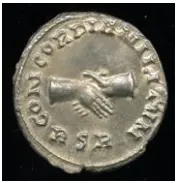

of the quotes he used on his coins, to put himself forward as the chosen person. This is the tweeter; the face book of its time. This is how they told the people what they wanted them to know. The illustration, right, shows him on a horse riding triumphantly, probably into London, and just speaks for itself. Hail the victor, hail the liberator! The present day spin doctors of government had nothing on this bloke! These coins, as with all those issued by each emperor, are used to communicate with the people and troops; they are the text of their time, the e-mails to all and sundry. This was the information and propaganda that helped an emperor stay in power once he was there! Unfortunately, like all men who hold power with the sword, the end is nearly always the same. Carausius had a finance minister by the name of Allectus and in AD 293 it was he who gained power over our man in the usual way. Carausius was assassinated, and Allectus took over, but only managed to hold the job down for just over two years. His time came to an end when Constantius managed to retake Britain for Rome in AD 296. By that time the hoard had already been in the ground for at least two years! Along with these five silver denarii came nearly 800 radiates of Carausius. This is the largest single number of his coins ever found and will keep the academics happy for years to come. The knowledge that will be gained from this pot of coins will be incredible, and it will be studied for years.

Final Siliquae Count
I have now found just about 70 siliquae from the first hoard, made up of whole coins, broken bits, and bent coins. The condition of the coins is overall not too bad, but if you take away all the clipped and broken examples, it doesn’t leave many in really top condition; but I was very pleased to find them! There is a photo of some of them at the beginning of the chapter, and I don’t expect to find any more except when the field is ploughed in a few years’ time, when I might come across a few bits and pieces. I am not finding any more now, so I expect that’s it; still I can’t complain, it wasn’t a bad find! These 4th century AD coins must have been hidden in the early 390s, so that is just about 100 years after the big hoard. This was probably a hoard of coins that had been disturbed by the plough years ago, and has been spread across the field every time it was ploughed ever since. Anna Booth found a reference to some
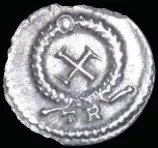
workers digging a ditch and finding some silver coins of the same type, in the same area of Somerset, in 1867. They may have found the bottom of the broken pot. All of these siliquae are of a fairly standard type, except one. This was a half siliqua, which are quite rare, with a picture of Roma on one side and a cross in a wreath on the other. The academics are still not completely sure what these half siliqua were for, or when they were made, but Roger Bland at the BM has written an article for the Numismatic Chronicle, making a good case for when and why. My coin comes from the Trier mint, shown by the TR under the wreath. Trier is Germany’s oldest city with Augustus establishing a base there in 16 BC, and it became a chosen city for many emperors after that. The picture of Roma is a standard portrait of the god of Rome. It seems likely that these small, rare coins were made just for a couple of particular occasions, like an emperor’s anniversary celebration, and were made to be given away as a gift. Going on what Roger and Sam have indicated it would seem a late 4th century date, in the 390s, is more than probable.

Talks and The Japanese
Early on I was asked to do a short documentary for a Brazilian TV company (you know how it is!). Since then the hoard has continued to attract attention, with plenty of offers to give talks to clubs and historical societies that are still interested in the coins. I have also been privileged to help Roger and Sam, from the BM, to give their academic talks about the hoard and the coinage of the time. All of these talks have the theme of Roman Britain at the time of the hoard, and the link with Carausius in particular. It was in late July 2011 that I had a call from ITV about doing an interview for a pilot show for a series on the PAS and metal detecting finds, and I did a day’s filming. I must say they did a good lunch (with a little help from M&S!), but the rest of the day was a bit of a letdown; but you can’t win them all! I was also lucky to help with a Japanese short documentary about metal detecting and we did this filming at a rally near Tiverton. It was a good weekend where a lot of our club members came and camped, and we had a good two days’ detecting; it was just a pity that decent finds were nonexistent! This left me with plenty of time for filming on the Saturday. It was shown on a Japanese late night show, but I never did manage to see it. What they wanted it for, still beats me, maybe it was a sketch thing, like Benny Hill!
Back Home!
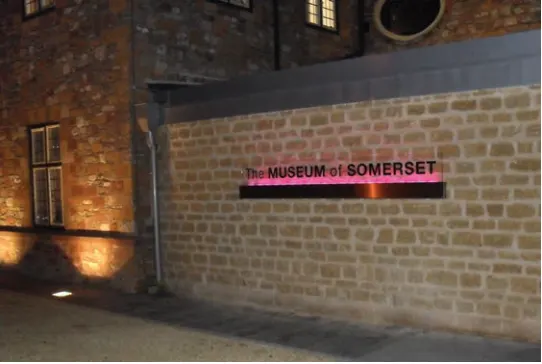
It was on 29 September 2011 that some of the hoard came back to Somerset, after its short visit to London. It is now housed in the Museum of Somerset, which is in the newly refurbished Taunton Castle. This building has been closed for two years and they have spent £6.5 million on this revamp, which has produced a really great backdrop for the hoard. This is now a really modern museum that is certainly worth a visit, and would make a great day out for all the family. It is also free to get in and there is a small modern café, which serves snacks and good coffee, with outside summer seating. They have put the large pot back together. I suppose for the staff at the British Museum it was just like a large jigsaw (all you needed was a bit of superglue and a lot of patience!). They must have been really pleased how carefully Alan Graham had taken it apart, kept it all separate, and well-marked, as he dismantled it piece by piece. So what we have now is the pot fully restored, seemingly full with coins right to the top; with the upside down black burnished ware “dog dish”, sitting just above it like a hat. A lot of the nice dark colour has now gone from the pot, and it has returned to its probable original colour, which was just a dry-looking grey. They don’t call this type of Roman pottery grey ware for nothing! Round the base there are scattered a couple of hundred of the radiates, which are all they have in the museum at the moment. The


five exceptional silver denarii take pride of place, on their own little plinth on the left. Around the glass display cabinet on the three sides are the stories, in photos, of the coins and a little of the excavation, with some of the people involved. This is only the first large display of the hoard in its new home in Somerset. The majority of the coins are still being cleaned and conserved in London and this is an ongoing job with two conservators working full time to get this work done. It is still going to take 18 months, as it’s a very slow process. Each coin has to be worked on individually, so they are in a condition that will last. As the museum receives more of the conserved coins back from the BM, the display will, I am sure, get bigger and better.
Slightly Technical Bit
On the day I found the large hoard I was using my excellent Minelab Explorer II detector. I had bought this off the Internet, and paid less than half price for a “nearly new” one. This detector has now served me well for a few years, and is still going fine. I have a deep and fast program on it, which Mick Turrell kindly set up for me a couple of years ago at a rally, and I have never found a reason
to change it. You have to get used to a little chatter as, if you are on a good site, it picks up everything; but you do know you are not missing anything if you pass over it. The signal on that day was iffy; on another day, and not looking for those little cut bits of siliquae, I might not have stopped and dug; and that’s quite a sobering thought! Would I have found this hoard with one of my other two detectors (old but still serviceable)? No, I don’t believe I would have, the top of the pot was just too deep.
Summing Up
So that’s about it for this story. From that first day in April 2010, when I just went out for a day’s detecting, through the initial discover, the three day excavation, and all the wonderful people who have been involved right through the last two years. This includes all the people who have helped me and have been involved with the coins at the British Museum, the two excellent FLOs, the new Somerset Museum personnel; and Alan Graham, the private archaeologist, who re-established my belief in archaeology! To all these people I would like to say thank you, you all did a fantastic job and I would not be writing this book without the help you willingly gave to the hoard and myself. So with 52,500 Roman coins under my belt, this means I am still the finder of the largest single hoard of Roman coins ever, and I will be till somebody, somewhere finds another bigger one. Is there another one out there? Well yes there must be, but was there a pot made larger than the Frome one? Who knows, but when it is found, I am sure it will be a metal detectorist who finds it. It has been a fantastic two years. I never did get to detect on that ploughed field in Somerset, but that field will still be there for me next year, or the year after. I hope everybody has enjoyed reading about my find, and if it starts some people taking up detecting correctly then I have achieved with this book what I set out to do.