6. The Dangers of the Farm
Pages 42–51

ne of the funniest things I have ever seen, a few years ago, was a member of our club being slowly chased across a field by a fat cow who obviously only wanted to be milked. The poor thing had been forgotten in the field and wanted to get back into the milking parlour. The cow was old and full of milk, and could not run, but it could bellow and the more it bellowed the faster my mate ran. However, that story has a serious side to it. Farms are one of the most dangerous places to work and so, by definition, can also be hazardous for us. Whether driving, parking, walking, or detecting, you have to take reasonable precautions. But by using the knowledge you will have gained in this chapter, and a bit of common sense, you can metal detect in relative safety.
Driving & Parking
The first point is when you are driving up the lane or track to the farm; you may encounter tractors, diggers, or Land Rovers pulling overflowing trailers with loads that would not be legal on public roads. Combine harvesters are probably the widest things you will meet, so are better given a wide berth. The same applies to the muck spreaders, but for different reasons. At least it makes the roses grow!
These vehicles are using the same track as you and sod’s law says they will be going in the opposite direction. Dave’s (first) Law says: “Give way to them, it’s easier”. Some of farm tracks are well paved and some are surfaced with tarmac. But others are like driving through a war zone, and you have to have all your wits about you. Look out for ruts, cow pats, and pot holes (big enough to swallow a small car), to say nothing of farm animals, children and a variety of domestic fowl such as chickens, ducks, geese, guinea fowl, pheasants, partridge and, potentially, even ostriches! And that’s even before you park. Don’t overestimate the ability of your family two-wheel drive saloon. Farmers have better things to do than tow you out of a ditch! If in doubt, walk! Where you actually park should have been agreed at your meeting with the farmer when you obtained permission; but you should always park in such a way that you are not blocking gates, drives, trackways, entrances to barns etc. So the most convenient for you near the fields, is not necessary the best place for the farmer. On a working farm, you will encounter tractors, trailers, combines, forklifts, or 4x4s all working in a tight area, which could involve turning or backing. So a badly parked car could hamper their work and endanger yourself and your car. There are nearly always places to park out of the way, and if you park there, then you are more likely not to be involved in any incident or accident.
Should I Detect Alone?
However you choose to go detecting, you have to think about safety, particularly if you are female. Obviously if you go detecting with a partner or a few members of your club, you can keep an eye on one another. It’s also good to have a companion so you can compare finds, and when you get the unidentifiable or a fantastic item it’s great to have somebody to show it to. But if you do go alone then take a mobile phone and ensure that you know the details of the farm. It’s a sensible idea to have the farmer’s mobile number (they are rarely at home) stored in your phone. This could be handy if you twist an ankle or discover the hoard of the century (it happens!). A normal size farm can have a dozen or more fields, and the majority of the time you could be well out of sight of anybody.
Rats & Ticks
A tick is a very small bug that lives on cows, pigs, horses, deer

and a lot of the smaller animals. During their life cycle they drop off into the grass to change hosts. This is where they climb up the stems of grass, stalks of crops or small bushes to wait for another animal to come along. They then attach themselves to the skin or hide of that new host where they burrow into the flesh. Being intelligent creatures they especially target metal detectorists as we walk through vegetation and where they can reach the skin of ankles and legs. They then proceed to suck blood and in so doing can transfer the bacteria which can cause Lyme’s disease. A rash can form, where you have been bitten, with a white ring. This is quite distinctive and can be particularly nasty. It can cause swelling of the legs, pain in the joints and muscles, with dizziness and palpitations and sensitivity to light. It is better if the ticks are removed early, but they are sometimes hard to see due to their small size. If found they should be removed with a pair of tweezers, taking care not to crush the body or its head. If in doubt, see your GP and think twice before detecting in shorts! Rats, which live in the countryside, can pass on Weill’s disease from their urine which can then survive in the water of puddles through which you walk. This is a good reason to wash or disinfect your hands before eating your lunch. I carry, in my lunch pack, a small bottle of hand disinfectant gel just for this purpose. The bacteria responsible for this problem can enter through a cut or wet hands if you were to wipe your mouth or get splashed from a puddle. The symptoms can be mild, but a fever is often apparent for 3 to 15 days. Throughout this period muscle pains, headaches, tiredness and aversion to bright lights, hallucinations, sore throat and a dry cough could also be present. Again, if you are unsure then seek medical advice. Having scared you all, both of these diseases are quite rare in this country, and I personally have never heard of a metal detectorist contacting either!
Aren’t Tractors Big!
When on farm land, or any other land, you should always be aware of your surroundings. Even with your headphones on, you must be able to hear any tractors, or any other farm vehicles, approaching which just might not see you if they are concentrating on what they are doing! Always give a cheery wave to the driver as he might stop and chat; also, before you know it, you might have
information that might lead to permission on another farm! Just walking across a grass field has a proportion of danger if you were to put your foot into a hole and twist your ankle - and that has often happened. A freshly ploughed field can have ruts a foot deep, with soft or wet soil hiding a multitude of dangers. Therefore walking over these can be treacherous.
Cows Are Big Too!

There are instances of people having been killed by cows, and these animals can be very dangerous. Cows are funny creatures to look at from the other side of the gate of the field they are in, but that can be deceptive. Young heifers can be very inquisitive - to the point of being a significant problem if you go into their field. Youngsters will always come and investigate you and it’s their curiosity that can lead to those at the back pushing forwards, and those at the front trying to back away. It’s at this point that they start to get excited and to turn, kick, and butt. Older cows are more docile, and normally okay when you are crossing their field; but they can be unpredictable. Cows may also think you are coming to feed them and, if feeling peckish can run towards you en masse. They will mean you no harm, but if you’re not used to this it can be very scary and potentially dangerous. So, what do you do? Remember cows are not normally aggressive so to fend them off just stand your ground, wave your arms about, and make a lot of noise. That should do the trick. Never, when attempting this, hem them in. Always give them an escape route so they can run away. When it’s all calmed down – go to another field! I personally never try searching a field full of livestock, there are plenty more fields they are not in.
Bulls Are Bigger Still!
They say that if you grab a bull by the ring through its nose you can lead him anywhere. I would say that whoever said that
had a death wish! Stay away from a bull; keep him in sight if you’re crossing a field, and don’t get in between him and his cows. He can run very fast, but how fast can you run? I don’t believe that farmers would put a dangerous animal in a field with a footpath crossing it intentionally, but does the bull know that? Dave’s (second) Law: if you don’t have to go in that particular field, why bother?
Horses
Like cows horses can be inquisitive but unlike bulls are rarely aggressive; on the other hand they are big and fast and can get quite frisky. Many horse owners are uneasy about detectorists going into the same field as their animals so unless you have specific permission, such areas are best avoided.
Sheep
Sheep are fine as they will always back away from you or run like hell. I have never heard about any trouble from a flock of sheep, and they have an added bonus that they taste nice. However, don’t go anywhere near them in the lambing season!
Unusual Animals
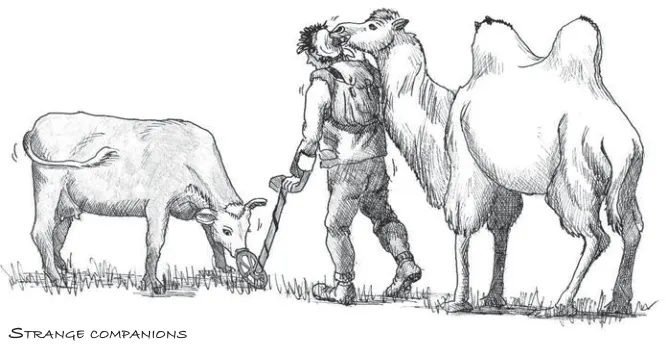
In the last few years there has been a tendency to have a range of somewhat unusual (if not exotic) animals on some farms. So to name a few you could come in contact with are llamas, alpacas, buffalo, camels, and ostrich: we are really becoming a cosmopolitan farming community.
Pigs
Pigs on a farm manage to dig up and move any amount of edible and inedible things, one of these items happens to be the field itself. They can manage to change a normal field into something that resembles a war-torn battlefield. Why would any sensible person detect on something like this? I just leave them alone and come back when the field has been returned to normal; what they haven’t managed to eat will still be there then.
Children, Pets and Other Animals
There are three types of children on a farm: yours, theirs, and other visitors’. Children don’t see danger as we see it; a farm is either a home where they have grown up or a place of enjoyment. When driving in or out of a farm watch out for kids and, if you take older children with you, make sure you know where they are and what they are doing at all times. In our club we have a few youngsters, which is great as we need young people to be interested just to keep the hobby going. But we emphasise that the parent must be responsible. Don’t bring small children with you to a farm – it’s just too dangerous. Likewise never bring the dog with you unless the farmer has agreed to this (which he probably won’t).
Mushrooms

Do you know your mushroom from your toadstool? Can you tell the difference between a Puffball and a Death Cap? No? Well I can, but I still don’t pick fungi in the fields. A few years ago, as a chef, I tasted a wild mushroom risotto that tasted fantastic, but tasting that dish did not make me an expert on the difference between an edible type and one that would lay me low or even kill me. You will come across many varied and different types of fungi when you are walking the fields and woods of this country. If you are an expert on fungi, or have a done a university course in the identification of mushrooms and toadstools then that’s fine; otherwise leave them alone, that way you will live to detect another day.
The Slurry Pit
This is like a swimming pool, or pond, filled with cow poo, urine and old hay. This, after being fermented to a deep thick lumpy
stew, is then spread across the fields to make the plants grow. There are normally warning signs around the pit, but your nose will tell you where it is. Stay well away, it can kill. I don’t know why anybody would want to get anywhere near it, but it’s not worth the trouble and contains few or no finds! It may seem that I am labouring all the bad points of a farm, but in with the pleasure you get from detecting you must remember what could happen. With common sense you can enjoy years of detecting without anything bad happening to you or yours.

Getting Shot
Many farms allow game shooting on their land; some even have organised game shoots at certain times of the year and this can be a valuable source of revenue for the farmer. The main game season for pheasants is from October to the end of January, but rough shooting (e.g. vermin: such as rabbits, grey squirrels and rats) can be going on at any time. Quite often people have permission for this just to keep the rabbit population down. So, although this tends to happen in the early evening, be aware at all times. You should make yourself aware of any shooting that might be going on in the farm, or in the near vicinity. Ask the farmer for the
dates of any organised shoots, and just stay away on those days. If you stumble across a shoot, beat a dignifi ed retreat to your car and, as you do, stay away from hedges - you might not look like a pheasant, but why take a chance? The majority of this type of shooting is with a shotgun, so the shot doesn’t travel far, but it can be a bit unnerving to hear a gun going off close to you. The “season” for game (i.e. when they can be shot), including deer, is different in different parts of the country; but it’s more prevalent from 12 August (grouse), round to the end of February (deer). There is some comfort as it is an offence to kill game on a Sunday or Christmas Day. I have always wondered if it’s because they can go to church? There are also gun clubs that do clay pigeon shooting where small round composite targets are fi red into the air. You tend to get a lot more noise, but they should be shooting upwards. So, unless you are a pigeon, and not too close, you should be safe.

Getting Blown Up
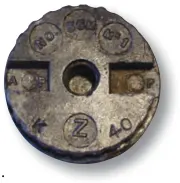
It’s very possible that you might dig up some ordnance (ammunition to you and me). The majority of items will be Second World War vintage, like the hand grenade base plug shown, but everything should be viewed with caution. Mortar shells, shell casings or ammunition could still be live even if badly corroded, and should not be handled. If you fi nd something that you believe is dangerous, then you should call the police. They, in turn, after inspecting the item will probably call the Bomb Squad. I found a live mortar shell from the Second World War, back in 2006; when I realised what it was I placed it in the ditch to keep it safe. This was to ensure my farmer didn’t drive over it while I called for help. After showing the police where it was, I got told off for digging it up and moving it. (It’s a funny old world, how can you fi nd out what something is, without digging it up?)
Lead
Lead has been used throughout the ages for the making of all sorts of items, and it is certain that you will fi nd your share of bits and pieces when out detecting. The Romans, in particular, were great lead workers. The soft metal corrodes easily to form a white coating of lead oxide, and this is toxic. If you have been unearthing lead your hands should always be well washed before eating your lunch, and resist the temptation of giving old musket balls to children.
Snakes
We are now scraping the bottom of the barrel of risks, as I have never seen or even heard of anybody seeing a snake when out detecting. But in Great Britain we do have two native types: one is the grass snake which is completely harmless; and the other is the adder, commonly called a viper. The bite of the adder is rarely fatal, but you should always get medical help as soon as possible. Adders are protected under the Wildlife and Countryside Act 1981 and so it is an offence to kill or harm them in any way. (Not that you were going to do so).
Places to Go and Fields to See
Farmers use any number of methods of dividing one field from another. Hedges must be the most common, and then fences, ditches, and walls, which are normally dry stone. Hedges, and dry stone walling also provide a home for plenty of birds and mammals. The common factor in all these constructions is that of gates, and these are there to be used. You will not be flavour of the month with the farmer if he sees you breaking down his field boundaries. The normal rule on farms is: if it’s open then leave it; if it’s closed, then close it behind you. In the latter case always ensure they are latched or locked. A barbed wire fence is very tempting to go under or over, until you ruin a good coat, or something more delicate. If a gate is securely locked, and reasonably sturdy, then it should be fine to climb over it…but be sensible! You might also come across an electric fence consisting of just one or two strands of wire that look very innocent. But why do the animals stay away from them? A few years ago we had a club outing when we encountered one of these fences and I, being a gentleman, held down the top strand with my digger (it had a rubber handle) for two girls to cross. I helped one over, and she held the other girl’s hand; however, that girl touched the wire. Watchers said it looked really funny all three of us twitching and jumping. Tony, unlike myself, always carries a magnetic compass in his rucksack. He can tell if the wire is live by looking for a deviation in the compass needle. (I had to look up the word deviation to see if it was legal).
Farm Watch
Finally, when you are out and about on farms, it’s worth keeping your eyes open for anything suspicious as there is an increasing amount of rural crime being committed. Farms are being targeted
by thieves for equipment and diesel. So if you see anything doubtful then it’s worth checking with the farmer, and if that’s not possible then a call to Farm Watch, run by the police, might be worthwhile. Farm Watch schemes and rural crime teams vary across the UK and contact details change regularly. If you need to report suspicious activity, check with your local police force for the current Rural Crime Team or Farm Watch contact information. With numbers on your mobile phone of your farmer and your local P.C., at least you can contact somebody and get it checked out. You can also contact Crimestoppers on 0800 555 111 or the police non-emergency number 101 . So if you haven’t been kicked by a horse, trampled by heifers, drowned in a slurry pit, poisoned by wild mushrooms, eaten alive by rabbits, or run over by the combine harvester, it must have been a good day’s detecting. Stay safe, and have many more.