9. What You Can Find – Coins
Pages 69–83
We are now going to look at the items that are possible to find when you go out detecting. These are going to range from coins to buttons; buckles to badges; rings to rubbish: good, bad and indifferent. It’s all out there for you to find, all it takes is a willingness to put in the time, and to learn as you go along. Man’s imagination to use the technology available to him, and to turn out objects that he needed and then lost, means that we can now find these items from all those years ago. The use of modern technology and modern farming methods, such as chemicals and fertilisers on the fields, are making some of these items corrode away at a much faster rate than ever before. This means that it is very important for us to find and record items before they disintegrate in the soil; we really are saving our nation’s heritage.
6,000 Years Of Finds
This is what it is all about. This is our hobby, and these finds will make you ecstatic, bored, mad, crazy, or pleased - probably all in the same day. In this chapter I am going to show some of the different metal items that it is possible to find. People living in this country have been losing their metal objects for over 4,000 years. It starts with Bronze Age axe heads, the Celts and their staters, and then 400 years of the Roman occupation. We then saw the Saxon raiders come and settle and Scandinavian Vikings, in the North, also left their goods buried for us to find. The medieval period, right across the country, saw vast changes in what people owned and subsequently lost. The Tudors followed, and Elizabeth I seemed to produce the most silver coins to be found of any monarch; they are found in their thousands each and every year. The Civil War, between the Cavaliers and Roundheads, saw some fantastic coins of all shapes going into the fields. Throughout the 17th, 18th, and 19th centuries, machine-made coinage and artefacts were scattered about in ever increasing numbers. Each generation of our ancestors has produced a different variety of items for us
to find, and we can uncover a small part of their lives when we dig these objects.
Coins
Before mentioning anything, let me say that you should as a priority get yourself a copy of a good coin catalogue, such as Spink’s Coins of England and the UK or, if you live north of the border, the Scottish equivalent. The values they give for coins may, or may not, be of interest to you (remember that FLOs are not allowed to give valuations) but as a means to identifying any coins you find they are essential and worth every penny. Even a book such as Spink’s catalogue is merely a general introduction, and if you get particularly involved in coins you will need to buy some more specialist volumes, particularly for Roman and Celtic coins. So we first come to the thorny question of what exactly was a coin for? Can we assume that a silver coin in the 18th century had a similar function as one produced in the early 1st century? Well, it is not for the likes of us to answer that one but it is an interesting thought, and we should not make simple assumptions about the world 2,000 years ago! One point that we can safely make is that, until the 20th century, the value of a coin was based on the value of the metal from which it was made; however, that is just not true anymore. A £1 coin is only “worth” that because I trust that I can use it to get £1’s worth of stuff at a shop; but the metal itself as scrap might only be worth a few pence. That was emphatically not the case in the past, and it is a line of investigation that I will come back to later on. Jettons, tokens and coin weights are not coins, and should always be considered artefacts. So what I intend to do here is merely guide you through some examples of the sort of genuine coins you might just find - the most general of general introductions! All the coins shown have been found by members of our club and are reproduced with permission.
Late Iron Age
If you are talking history, the term “Celtic” is unhelpful and
increasingly controversial; it is much better to talk of the “late Iron Age”. But with coins you just can’t escape the word and so, reluctantly, I will refer to Celtic coins and hope I don’t get told off by any passing historian. Now I’d better own up as I’ve never even found a Celtic coin, although one is high on my wish list; but they do turn up and you may well be luckier than me. Only, that is, if you happen to live in the parts of Britain dotted in the sketch map. It shows a distribution of all Iron Age objects recorded with the PAS and the bias is clear. So if Devonshire or Cornwall is your patch - or Wales, the North West or anywhere in Scotland - then I fear it is just not going to happen without some long distance travelling to potential sites being involved. They are coins like no other, are usually made of silver or gold, and have the most beautiful abstract designs, often involving horses. Even the names are strange: “staters”, “quarter staters”, and silver or bronze “units”. The world of Celtic coinage is technical and complex, and much about them is still not understood. The fi rst coins made in Britain come from about 100 BC, although it seems that imports from Gaul (France) existed before that time. Regional tribes each had their own coinage and, in a time with no written records, the type and distribution of these coins can tell us much about political boundaries and trade about which we would otherwise be ignorant. Indeed, such tribal identity may even stretch across the Channel with identical coin types often found in, what is now modern Belgium or Northern France. With the Roman Conquest of Britain in AD 43, the brief fl ourishing of Celtic currency came to a sudden end. The right hand example has a stylised horse, facing right, over a chariot wheel on the bottom, which is a quite common motif. In the top right hand quarter is a design that looks, to me at least, a bit like a torc (such as those found in the famous Snettisham Hoard). The reverse on some Celtic coins is simply blank!

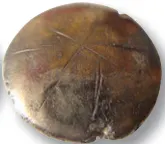

In the second example, above, which has a diameter of 10mm, the horse is facing left but still straddles the wheel, and has a stylised head of Apollo on the other side. Another iconic image to appear on these coins is a sheaf of wheat. It seems probable that horses, chariots and agricultural production were the symbols and reality of power for these pre-Roman societies. Of course, the examples shown look totally different from modern coins because they lack any writing or a representation of an individual ruler. In the years before the Roman invasion proper, and as Roman infl uence inevitably grew, this began to slowly change. For the fi rst time in British history we have the names of people appearing on some coins, which began to evolve a more Romanised feel to them. What were the territories of these Celtic tribes? The sketch gives a rough idea and by recording any coins you fi nd you will help the academics get a better sense of what was going on in this mysterious period.
Roman Coins (AD 43-c.350)
For this period, of about 300 years or so, coins are found in huge numbers and just about everywhere (in stark contrast to what followed in the 5th and 6th centuries). The nature of trade and the construction of roads for the movement of goods, all meant that a coin-based economy developed. The coins themselves set the standard for all those that followed, and look much more like modern coinage than the Iron Age examples above (“Britannia”, still found on the older 50p piece, fi rst appeared on Roman coins). The emperor, or occasionally his wife, appears on the obverse, which gives the coin authority and also serves as a political statement for the ruler himself; a reminder that any wealth you might possess was dependent on the goodwill of the guy whose face was on your coins!
Roman coinage is a massive and rather daunting subject, and there are hundreds and hundreds of different coin variants and many different denominations that themselves varied over the centuries. Specialist coin books are listed at the back of this book; but don’t go rushing into the bookshop until you’ve established, at least the beginnings of, a collection. You might just come across a coin that predates the invasion which, we can speculate, came across to these islands because of trade. These belong to the “Republican” period of Roman history (up to 27 BC), and look quite a bit different from those that followed. This silver Republican denarius has a serrated edge (a serratus) the purpose of which is, as I understand it, still unknown. After the Roman invasion coins were imported into Britain from mints all over the Empire and it can be fascinating to fi nd out where some of the coins you fi nd were actually made. Some were offi cially minted here, usually in London, but later on unoffi cial coins appeared in large quantities. Between the invasion and about AD 250 there were fi ve types of coin as listed below.

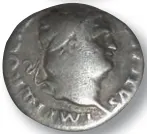
- The aureus (literally means gold). If you are lucky enough to fi nd one of these coins, you have my permission to go dancing down the street! They are very rare indeed.
- The denarius (penny, plural denarii), was originally solid silver but like those below later ones can be merely silver “washed” meaning that they are copper coins with a thin coating of silver on top. We still used the word for our pennies until decimalisation in 1971 (i.e.1d).
- The siliqua (plural siliquae) was solid silver. The mint marks are at the base of the reverse (e.g. Constantinople and Trier in these cases).
- The sestertius was a big, heavy copper-alloy coin. Some of these can be quite worn as they were in circulation for a long time.
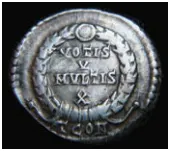
- The dupondius and the as (now don’t laugh, this is a serious business) were smaller copper-alloy coins. I, for one, am not very good at telling them apart.
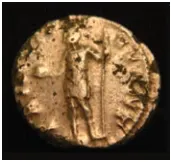
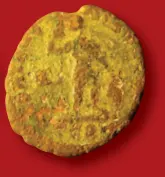
By the middle of the 3rd century, the coins above had pretty much disappeared and were replaced with coins that we call “radiates”. The name comes from the spiky looking crown which actually represents the sun’s rays. These coins are extremely common fi nds on the fi elds of England and cover a period of between c.AD 215 to the end of the 3rd century. (These were the coins that made up the Frome Hoard, with only fi ve denarii in with them.) Early radiates had signifi cant silver content, but with time (and possibly infl ation?) they became smaller and increasingly coppery. Many home-made copies of radiates were produced, called “barbarous radiates”, although it is not easy to know to what extent these were offi cially sanctioned or just blatant forgeries. The example on the right is a “silver washed” radiate, and you can see how the thin layer has worn away showing the copper alloy beneath. In the 4th century the coinage changed again and a range of new copper-alloy coins appeared, collectively termed nummi (singular nummus). The nummus on the right is of Constantius II and dates to AD 348-350. The reverse is quite dramatic (to me at least) as it seems to show a soldier leading a child to safety and away from a building on fi re! I think that the reverse images on some Roman coins can be much more fascinating than the bust of the emperor on the obverse. Before we leave Roman Britain, please don’t be fooled by the photographs above. Although it is possible to fi nd coins in excellent condition, most coins will be small and grotty; indeed we call them exactly that - “grots”. The coin below right is typical of those I fi nd, and is by far not the worst! Some will be barely recognisable as coins and you may not even be able to make out the bust, let alone any writing. However, these too, should be recorded with the PAS, as they also have their story to tell.

“Roman coins make up the vast majority (64%) of coins recorded (and this total excludes coins found in hoards, such as the Frome hoard of 52,503 coins) - it is the largest open-access database of Roman coins in the world. Because so many Roman coins have been found it is not surprising that a significant number of unrecorded types and new varieties have come to light. In this way, detector finds are adding significantly to our knowledge of Roman coinage in general. This is especially the case with coins struck in Britain by the usurpers Carausius and Allectus (AD 286-96) and for coins struck at London which was a mint from 286 to 325. “The new edition of the Roman Imperial Coinage for Carausius and Allectus will contain a large number of previously unknown coins recorded with the PAS. Furthermore, future volumes of RIC covering the Tetrarchy and House of Constantine (AD 296-325) will contain a number of new London mint coins. However, the PAS probably provides the largest corpus of new material for contemporary copies of Roman coins, mostly made in Britain. We have added about 600 Claudian period copies, over 1,000 Severan period copies of denarii, and many thousands of radiate and nummus copies of the late 3rd and 4th centuries. This enormous dataset of “irregular” coins will provide future researchers with the largest known corpus of contemporary copies from Britain. In addition, the PAS has recorded a significant number of Roman gold coins which are included in a recent book. The data is also changing our understanding of late Roman silver coinage in Britain. Finally, almost 100 Byzantine coins have been recorded, overturning the view that Byzantine coins were all lost in the modern period. “In addition to new numismatic data, the recording of Roman coins is leading to a national picture of Roman activity. Because so many detectorists have been showing us their “grots”, there are over 900 parishes from which more than 20 Roman coins have been recorded; a few have over a thousand! In many cases these assemblages represent new Roman sites and in some counties our knowledge of Roman settlement has been changed greatly - for example on the Isle of Wight and in Devon. “Furthermore, by analysing the chronological spread and density of the coins we are able to make preliminary assessments about the date range of occupation at particular sites. Such studies can be expanded to show regional patterns - for example, Philippa Walton has shown that in the southern and eastern parts of Britain, 3rd and
4th century coins are most common; in the Northern and western parts of the country, there is a relatively higher proportion of 1st and 2nd century coins.” (Sam Moorhead, National Finds Advisor for Roman & Iron Age Coins, Department of Portable Antiquities and Treasure in the British Museum.)
Saxon & Viking Coinage
You were probably taught at school that the Romans left Britain in the mid-4th century and the Angles, Saxons and Jutes (in Kent) took over. But only when you have detected for a few years does it hit home what a cataclysmic change this represented. Early Saxon coins are as rare as hen’s teeth, and although coinage makes a recovery in the late 13th century, and again in the time of Elizabeth, it is only in the 18th century, and the dawn of the Industrial Revolution, that I would say that coins fi nds are as common as those from the Roman period. That is quite a thought! No coins at all reappear in England until the middle of the 7th century. I say “England”, but the reality of that word was still a couple of hundred years away and instead we had a series of separate petty kingdoms which spent most of the time fi ghting one another. From the cauldron of those related power centres such as East Anglia, Northumbria, Kent, Mercia and Wessex and, most importantly perhaps, the external Viking threat, would grow a nation; but let’s not get ahead of ourselves. Early Saxon coins, called sceattas and pronounced “skeets”, were small (less than 1cm in diameter), and tried to imitate Roman currency. The designs were copies of copies of Roman coins and became quite abstract and unrecognisable. By the late 8th and early 9th centuries, silver coins were being minted which were larger, of better quality, and clearly the forebears of the later medieval coinage. Names of rulers were clearly shown on coins. Any Saxon coin is a wonderful and valuable fi nd (I’ve never found one) and I personally think the later ones are quite beautiful. This is a silver penny of Aethelstan, King of Wessex between AD 924 and 939. He was the grandson of Alfred the Great and managed to unite all of England and much of Scotland under his rule. This coin is in absolutely wonderful condition and (don’t tell you know who) I would rather fi nd this single object than a Roman hoard!

On the right is a rare “cut half” of Eadmund, Aethelstan’s younger brother, and King of Wessex between AD 939 and 946; a lovely find, but still a shame that it wasn’t complete. Of course, all coins from the Iron Age to Charles II were made by hand (okay, not quite true, but almost) and are called “hammered” coins. These were made by inserting a blank silver disc between two, much harder, steel dies for the obverse and reverse images, and whacking it with a great big hammer to make the impressions. Lots of things could go wrong with this; for example, the silver disc might not be central to the die and the image would not be in the middle of the coin. Or, perhaps after a heavy night out, the guy with the hammer might use too little force and the image appears weak. You even see coins with a double image, where there had been two attempts at getting it right! These will always detract from the appeal of the coin to a modern collector and, hence, its value, but not to the interest from the detectorist. Until the time of the recoinage of Edward I, in 1279, it was usual for the name of the moneyer to appear on the coin. This was the person who, while not actually wielding the hammer, was responsible to the king for the quality of coinage coming from the mint. By putting your name on the coin you could hardly hide any deficiencies! Of course, in a pre-industrial age there was a limit to how many coins any one mint could produce and so they opened up (and often closed down) in major towns across the country throughout the medieval period; and it usually possible to identify where your coin was made.

Medieval Period

The medieval period I will take, for the purposes of this chapter, to be 1066 to the demise of Richard III in 1485. Coins of the first Norman kings are very rare and you might detect for 25 years and never find one. The only coin in existence was the silver penny and this, and the political instability in the country, presumably did not encourage trade based on coinage. By the time of Henry II (1154- 1189) things had eased a little and larger numbers of very poorly made silver pennies appear. They are called “Tealby” pennies after a hoard of 5,000 found in Lincolnshire in 1807. Why they are of such bad quality I have no idea, but there it is.
One reason that hammered coins (usually!) had to be well made was to avoid clipping. Remember that the coin’s value was based on the metal from which it was made. So, unscrupulous traders would take small shavings, or clippings, off the coins that passed through their hands, hoping that the customer would be too busy to notice. This would provide a handy little side line and illicit profi t! Of course this was strictly illegal and the penalties could be severe. However, detectorists regularly fi nd clipped hammered coins, so it obviously went on as can be seen on this half groat (2d) of James I. If a coin is usually a perfect circle it is easier to notice where a little has been removed and you can simply refuse to accept it. If good and bad coins come your way, then you are more likely to spend the clipped ones (if you can get away with it), and keep the perfect ones. If everyone does that, then the coins in actual circulation get rapidly worse in quality, and confi dence is lost in their value. Numismatists call this Gresham’s Law (i.e. that bad coinage drives out good). Eventually this could have had an adverse effect on medieval economic growth and for the state became a serious issue. So every now and then there would be a recoinage, with bright new shiny coins replacing the old corrupted ones, assuming the new silver was available. At the same time, the design of the coins would be improved to try and make clipping more obvious. On the right is the short cross penny, brought in by Henry II in 1180 to replace the Tealby penny. Its innovation was to encourage use of coin by allowing “small change” to be created. The doublelined cross meant that when it was cut into halves or quarters; one line of the cross visibly showed it had been done fairly (see right, although this is a slightly later coin) or even quarters. So literally “half-pennies” or “fourth-things” (later called farthings) could be made for use in the local market. It might not be that clear from the image, but the obverse starts by spelling HENRICVS, which is fair enough you might think. Alas the coins hardly changed for the next three kings, so HENRICVS it stubbornly remains for Richard I, John and Henry III! If you want to identify these then record them and get the museum to do it for you! It was Henry III who, in 1247, introduced the long cross penny where, on the reverse, the cross was extended to the edge of the coin. This was to try and


reduce clipping and improve the quality of money in circulation. In 1279, in a major recoinage, Edward I took it a stage further and had the long cross splayed at the end (so it was clear where the coin edge should be). The difference between the short and long cross is obvious from these two coins. The lower coin is a penny of Edward II, and was minted in Durham, land of the Prince Bishops, as can be seen by the top part of the cross which is actually a bishop’s mitre! The country was becoming richer and the number of coins that detectorists find rapidly increases with Edward I and his immediate successors. It is far from easy to tell which Edward you have on your coin as the rather two dimensional portraits look quite similar and, unhelpfully, the coins just say “Edward”. Worse still, we are still 200 years away from some bright spark having the idea of including dates. One useful guide is to look at the lettering and if you see a lower case “n”, called Lombardic script, then it is probably Edward II (1307-1327). An upper case “N” could mean Edward I, as could “EDWR” at the start, whereas “EDWA” would be Edward II or III. Another good tip is to look at the crown, which consists of a central part and two side pieces. Ignore the centre and just look at the side; if it is in three small divisions, trifoliate, then it suggests Edward I, whereas a bifoliate division is likely to be Edward II. As for Edward III (1327-1377), look for the “pop star” hair, like this one on the right. It’s much bushier than for Edwards I or II. The reverse inscription reads CIVI TAS LON DON, meaning that it was minted in the Tower of London. The obverse starts with a cross (at 12 o’clock) then EDWA [R AN] GLoDNSHyB which, roughly translated, means “Edward King of England and Lord of Ireland”. A proper reference book will give you a full list of medieval mints and when they operated but, just to whet your appetite, here are a few of the more common:

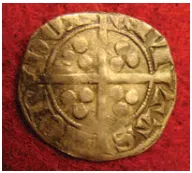
York...................CIVI TAS EBO RACI Durham .............CIVI TAS DUN ELM Canterbury.........CIVI TAS CAN TOR Calais.................VILLA CALESIE
For the majority of the population there was a desperate need for smaller denominations. Cut halves and farthings were gradually replaced by properly minted smaller coins. At the same time, quite beautiful larger coins were made with the groat (4d) appearing
along with the half groat (2d); the word meaning “great” coin. Having a wide range of denominations provided a stimulus to trade, and at the top end gold coins made a return to England, not that your average peasant would ever see one, and neither, unless you are very lucky, will you!

Tudor & Stuart Hammered Coins
The design of English coins remained largely unchanged for 200 years. It was not until Henry Tudor, a Welshman with a weak claim to the throne, emerged triumphant from the protracted War of the Roses, and became an unlikely Henry VII, did the style begin to change. With his son, the infamous Henry VIII, there was major reform (notice the profi le bust of the Henry VIII groat on the right, and the new heraldic shield on the reverse). Most importantly, and controversially, was the devaluing of coinage. In an effort to pay for his foreign wars, and his extravagant lifestyle, Henry VIII did what all the medieval monarchs had resisted and reduced the silver content of the coins by alloying them with copper. Indeed he became known as “Old Coppernose” because it was said, that shortly after minting, the fi rst hint of wear would rub the silver off his nose revealing the copper underneath. This debasement gave him a short term fi nancial boost, (the modern equivalent is quantitative easing – nothing changes!) but it simply pushed up infl ation making people poorer and was very unpopular. His daughter, Elizabeth, when she came to the throne, tried to put things right and issued coinage with a higher purity of silver. Elizabethan hammered coins are, by some way, the most common to be found and she produced a bewildering variety of coin denominations. Perhaps due to the length of her reign, the coins are often pretty tatty when we recover them, but you might be lucky! On the right is a shilling found very recently and it is in stunning condition. We now have dates, on most coins at least, and the Tudor Rose to the right of the bust on every other denomination - no doubt to help people more easily identify the coins. An odd feature of Elizabethan coins is that the queen’s bust is commonly more worn than the reverse. I have heard it said that this is because rubbing the head with your thumb brought good luck! Did people really think that at the time? I have no idea, but it’s a nice story!
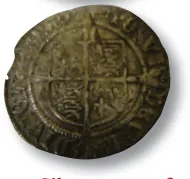

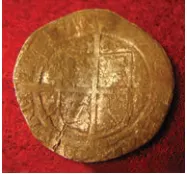
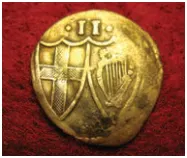
The two coins above illustrate an interesting point about currency of all periods. On the left is a genuine “Lizzie” sixpence of 1578, but that on the right, dated 1569, is a contemporary forgery. It is physically a bit smaller (24mm diameter not 26mm), the silver looks to be debased, and the quality of the die is much lower – look at the reverse shield on both and see the difference! If you find a coin, of any period, that “looks wrong” then there just might be a reason for it! Moving to the 17th century, and the last few decades of the handmade hammered coin, the shilling (12d) of Charles I, right, looks very similar in design to the sixpence above. Annoyingly, we’ve lost the date, but gained the denomination in Roman numerals and this continues in the half groat (2d) of the Commonwealth, below right. This coin shows the emblems of England and Ireland, but any trace of a monarch (or Scotland for that matter) is missing. During the Civil War, very odd looking, and rare, “siege money” was issued from royalist towns such as Carlisle or Newark but, sadly, I think that’s a little beyond the scope of this book!

Milled Coins
With Charles II onwards, coins were machine made, “milled”, and look much more familiar to us. The thicker edges to these machined coins gave Sir Isaac Newton, of all people, as Master of the Royal Mint the opportunity to introduce those little ridges, still with us today, that once and for all got rid of the medieval scourge of “clipping”. The other great change was the mass introduction of copper alloyed coins, although this occurred in fits and starts right until the early 19th century. Inflation had increased the value of
silver and the size of a silver penny, or still worse a halfpenny, was now just too small to be practical. The only sensible solution was to have copper coinage and, as the 18th century progressed, the Industrial Revolution and the increased population in the towns, who needed to be paid, made the problem far more immediate. The patchy response of the state to these demands led to several waves of unoffi cial copper coinage (see the bit about jettons and tokens below) but when proper coinage was minted it was done so in very large numbers, and these are some of the most common coins that you will fi nd. On the right is a halfpenny of George I, dated 1721. These coins, from William III through to George III, seem to be much more common than the larger penny and, judging from the often much worn condition of the coins that we fi nd, were in circulation for many years. To the right are halfpennies from George II (1731) and George III (1773). You can see that the direction of the bust alternates with each monarch (it still does) and this can be helpful in identifying badly worn coins. A common, if slightly mysterious, fi nd is an 18th century coin which has been deliberately bent into having an “S” profi le. We often describe them as love tokens, but quite how they were used I really don’t know. Perhaps they were buried by the loving couple; perhaps thrown away after a row! The one illustrated is a bent George III halfpenny, but they are often made out of worn silver coins. Another deformed coin is this George II halfpenny which has had a crude rim added. I have seen several of these and can only assume it was to allow them to be rolled in some sort of game. Although pennies crop up less frequently in this period, an exception is the “cartwheel” penny of 1797. These were produced by George III to rid the country


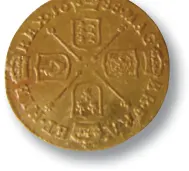
of unoffi cial tokens, but they were bulky, heavy and unpopular. A pocketful of these would have certainly weighed you down! Throughout the 19th century, coins became perfectly manufactured and, in the 20th century, gradually less important as paper money took over. After the First World War, the silver content of “silver coins” became less and less until, today, it is zero. Indeed, the copper content in “coppers” went the same way until today they too are largely copper free. The value of the metal in modern coinage is only a small fraction of the face value and exchange is based on trust, although I am informed that perhaps 5% of pound coins in circulation are counterfeit – some things do not change! Although coins from the last 200 years or so are unlikely to be rare or valuable, and your FLO will not be interested in them, they can still be good fi nds. The George IV shilling, from 1829, and even the George VI penny, from 1938 (above), are in such lovely condition that I still think of them as some of my best coins, and another seasoned member of our club once told me that his favourite coin of all was a Victorian sixpence! But I cannot bring myself to fi nish our brief survey with a copper penny, however nice it may be. Maybe, just maybe, if you make a very powerful wish over your birthday candles, you may fi nd a gold coin. I never have, but some do and, so you might recognise the colour, I present two coins found by friends of mine, both guineas the fi rst a guinea of James II dated 1688 (right), and the other a guinea of George III dated 1775 (below).