10. What You Can Find – Artefacts
Pages 84–117
What is an artefact? Basically anything that isn’t a coin! The variety of objects that you find tells you everything about the wealth of the society that lost them. Throughout history, if you had money, then you spend it on “stuff” and it is no surprise that the greatest variety of metal objects we find date from the Roman period, and then from the Industrial Revolution onwards. Artefacts can be much more personal than coins and, as some detectorists argue, bring you closer to the people who owned them.
Brooches, Badges, Pendants & Mounts
This is a broad topic and many of the objects that I will look at do not sit that well in each other’s company; but at least we can look at a wide range of objects in one section! The heyday of brooches was in the very late Iron Age and early Roman period. The top example is from the late Iron Age and has a style described as Le Tène. Like some of the later Roman examples, to modern eyes this is a glorified safety pin, although I’m not sure that is a fair description of such a beautiful object! It has a lovely green patina and understated decoration. It is elegant in the extreme and would not look out of place in the 1920s. These seem to be Celtic interpretations of Roman brooches that were, presumably, appearing through trade. The Roman example, lower right, is lovely in its own way but the decoration is a little less free

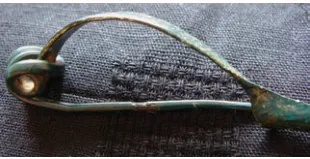

fl owing and more, well ... Roman. You can clearly see the catch plate for the pin. Some fi elds will give large numbers of these bow brooches and, given that they broadly fell out of fashion by the end of the 2nd century; that might tell you something about the site. These two examples also show the difference between a hinged pin (bottom) and a sprung pin (top). Nine times out of 10 they have lost the pin, but if you are very lucky you will fi nd one intact with the pin, and possibly even with some decorative enamel like that shown above right. There are various sub groups of these brooches, which we will not worry about here! Other Roman brooches are zoomorphic (made to look like an animal). Here is a chicken brooch and a beautifully stylised horse’s head brooch, but hares (not rabbits - they were introduced by the Normans!), birds and fi sh are common. Remember that they would originally have been a radiant polished copper colour and not the green we see today! Other Roman brooches are different again. The onebelow right looks to all the world like a piece of Victorian costume jewellery, but it’s not; so be careful what you throw away, particularly if you are new to the hobby! Indeed the variety of Roman brooches is remarkable. Some are quite phallic, and they did seem to have a thing about a winged penis but, as this is a family book, I have shied away from illustrating that! More respectable are enamelled disc brooches and others that can be in the shape of surprising objects such as a shoe, a knife, or almost anything! As with most things Roman, brooches were produced on a large scale, certainly by the standards of the ancient world and traded both locally and across the Empire; there is even evidence to suggest that broken brooches were recycled! An enamelled disc brooch is shown that must have looked quite beautiful when new, and a “shoe” brooch with traces of the enamelling left within.


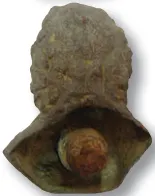
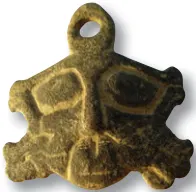
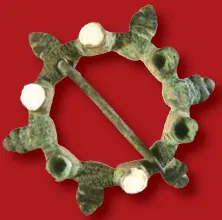
Brooches in the form of a ring can be found in any period. If the ring is complete they are called annular and, if there is a small gap, penannular. Decorated annular brooches, particularly silver ones, may well be medieval but rather plain; copper alloy (or even silver) penannular ones are most likely Roman. They have marked terminals and a simple pin that is larger than the diameter. A mount is anything that fi xes onto an object instead of a person and, given their love of “things”, it follows that Roman mounts also crop up, and in many forms. I will show just one, a quite wonderful furniture mount found by a club member. I am embarrassed to admit that when I fi rst saw this object I tried to convince the fi nder that it was Georgian. “Look at the hairstyle!” I cried. Well I feel a fool now, but the moral of the story is that the more objects you handle the better at identifi cation you get, and be very cautious when making statements about unusual items! Anything Anglo-Saxon (still more so if Viking) is a rare fi nd indeed. Some early Saxon brooches show a direct evolution from late Roman ones, although they soon developed their own style and begin to look quite different. Anything with swirly patterns or with abstract intertwining “beasties” should raise your suspicions, but don’t get too excited too soon! However, just to show that Saxon things do occasionally appear, here are a couple to look at. That on the right is a variation on a disc with a raised rim and is called, sensibly, a saucer brooch. It is early Saxon, 5th or 6th century, and may well have been originally gilded. They are predominantly found in central Southern England. At the other end of the Saxon period is this, rather haunting, 11th century stirrup mount in the form of a human mask. These too seem to crop up in the area of “Wessex”. This one appears to have been reused as a pendant. In the medieval period most sorts of decoration seemed to focus on the power of the aristocracy or the church those who fought or those who prayed. Hence mounts and pendants are often either heraldic or ecclesiastical in nature. The following example is a pilgrim mount, perhaps of 13th


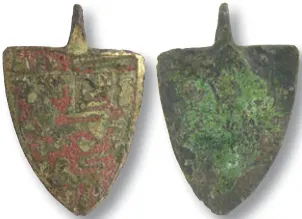
or 14th century date, and this might have been bought at a site of pilgrimage, perhaps Canterbury (St Thomas a Beckett) or Durham (St Cuthbert). Such places seemed to have done a roaring trade in religious “souvenirs”, which might include a pilgrim badge or a small lead bottle of holy water (an ampulla) kept securely around your neck with a light chain for your return journey. The heraldic shield, on the bottom right, is a horse harness pendant. It has a suspension loop at the top and the remains of once very fi ne enamelling; in this case it shows the three lions of England, the royal crest. It would have been one of several hanging from a knightly horse and purely decorative in nature; they are not unusual fi nds (image courtesy of the PAS). However, to fi nd one in excellent condition is very rare and, I imagine, rather exciting. I actually found one of these myself but the condition of it is so embarrassingly poor that I couldn’t bring myself to include a picture. Shown on the right is a rather fancy medieval annular brooch (image courtesy of the PAS) with an intact pin. This one has coloured glass stones in mounts around the rim although some have fallen out. Others of this type have decorated silver rims.

Buckles & Strap Ends
You will fi nd buckles - lots of buckles! It is easy to look down on them as being humdrum objects of everyday life but metal detecting is mostly about that; only rarely do we fi nd real treasure! So we ought to know a little about the buckles we fi nd as that makes our day a little more interesting. In the Iron Age, you (very occasionally) come across things called terret rings - beautiful objects used for horse harnesses. Roman buckles are often zoomorphic, meaning they take the shapes of animals. A typical Roman design is to have the heads of animals, usually “dolphins” or horses, facing each other at the end of the loop.

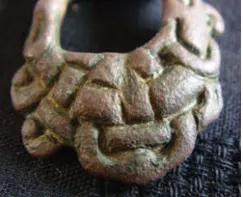
Next, we take a quick look at a superb Viking buckle (right). The design is intricate and complex; and, if you look hard enough, you can spot intertwining creatures in such forms. I had to include this image as it is such a wonderful object; however, let’s come down to earth and look at more common finds! All of the above are rare and so - before we get carried away with Celtic chariots - let’s focus on what you are likely to find in your field! Buckles have different styles and, to a point, these did come in and out of fashion. But the design of a medieval buckle might not be that different from the one you may have on your belt as you read this; after all they are primarily functional. So the best we can do is illustrate a small but typical selection with descriptions and some rough dates. If you want to know more then I recommend the book by Ross Whitehead (see the “Further Reading” section).

First (above) we have a typical medieval example. This is a single-looped buckle with attached plate and a roller bar on the loop. The pin has been lost (sadly) but some of the studs are intact as is the leather inside the plate (honest!). Of course, you might just find the plate or loop separately. Dating is hard but this buckle is probably late 13th to early 15th century. A single-looped medieval buckle is shown right, this time with the pin, and with two clearly protruding knobs. It was probably made in the late 13th to late 14th century. One of the giveaways is the imperfect casting of the pre-industrial age; the later buckles below are just a little too perfect! On the right is an annular (circular) buckle. As always, this is hard to date with any precision but is probably a little later than the two above, at anywhere from the late 14th to 16th centuries.
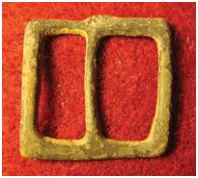
The degree of decoration found in medieval buckles varies enormously. At one end they can be quite plain and functional. Then a little rustic decoration creeps in; and finally, for those who had the money to pay, there were beautifully made exquisite objects of solid silver or with gilding. See Benet’s for some examples of the latter, but remember they are far from common finds! These three little buckles are again cast copper alloy and are typical of the sort of thing you might find. The simple designs might suggest they are of an early date, but you really can’t be sure. The left one is called a spectacle buckle and the right one a rectangular buckle. They were probably made in the 15th century but could be as late as the early 1700s. The third (lower left) is a trapezoidal buckle. As for their use, that too is hard to say. They may have been part of clothing but, on farmland, may equally have been used for leather straps for horse tackle. The interpretation of buckles can be a frustrating business! As we get towards the 17th and 18th centuries identification gets a little easier as decoration becomes more commonplace. Compare the buckle above on the green background, from the 1600s, with the three mentioned above. It is a double loop asymmetrical buckle and, although it can hardly be described as ornate, there is a slight sense of fashion here and that, perhaps, reflects changes in society. The Middle Ages were gone and the middle class, with that extra disposable income, was on the rise. To continue the theme, here (right) is another spectacle buckle, but this is also from the 1600s and you can see the same modest decoration creeping in. The object is also a good reminder of how the iron, of the pin, corrodes far more rapidly than the copper alloy of the buckle. Finally here is a shoe buckle I found lying on top of a ploughed field. From the 18th century, you can see that the style of the object has become as important as the function. The crossbar and pin are missing and the outer frame is broken but, even so, the decoration is clearly visible throughout; indeed people mistake it for a small picture frame!


If buckles are a common fi nd then strap ends are not. As the name suggests they are simply ornate metal endpoints for leather straps, popular in the Saxon and medieval periods. Here we have two Saxon strap ends. The fi rst shows wonderful interweaving scrollwork beloved by Saxon craftsmen. This rare object would be a terrifi c fi nd for even the most experienced detectorist. The second is zoomorphic, another Saxon theme, and looks like a dragon with a long neck and haunting eyes!

Buttons
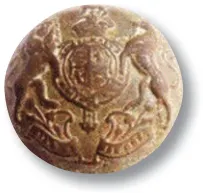
When out detecting we all dream of hammered gold or a beautifully enamelled Roman brooch - well I do at least. The reality can often be a succession of shotgun cartridges or veterinary mastitis tubes On the scale of desirable fi nds buttons sit just on the border between rubbish and “mild interest” but rest assured you will fi nd many, many buttons so you might as well make the most of them! Before the age of plastic, buttons were all metal and they apparently fell off clothing constantly! It’s no surprise that we also fi nd lots of thimbles in fi elds - evidence of on the spot repairs! Yet, before you throw your buttons straight into the recycling, pause and have a good look at the humble objects as some really are mildly interesting and, in fact, can be worth more to collectors than the average silver hammered coin. Personally, I am rather fond of “livery buttons”, which were worn as a sort of uniform identifying the particular member of the landed gentry for whom you worked. The designs are based on heraldic images and often sit on a straight piece of twisted rope; sometimes it is possible, with a bit of research, to identify the aristocratic family from the emblem. Unfortunately, as they are less than 300 years old (probably late 18th or early 19th century), you might have to do the research yourself unless you can charm your FLO into making an exception and doing it for you. Because I live on Salisbury Plain I accumulate a fair few military buttons, and there is a new book to be written on that subject alone (though not by us). The earlier infantry buttons have the regimental number written clearly upon them and, if you wish, you could then fi nd out a little of the regimental history. So, for example, the button on the right is the 66th Regiment of Foot.
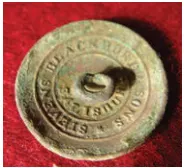
Later buttons were of a more standardised “royal crest” design. How old is my button? Your starting point, as with most objects, is the quality of manufacture. If it is machine made it will look perfectly round, probably with stamped writing on the back, and the attachment loop will be perfectly centred. If it all looks a little “rough and ready” it was probably made locally before the Industrial Revolution. If so, you may fi nd the design on the front is also a bit hit and miss. Buttons of this period may have fl oral designs, weave patterns (see right) or simply a geometrical shape. Some buttons will remain a bit of a mystery. The example on the right has the Prince of Wales emblem and the initials HH. No doubt somebody will know what this means but I don’t - so please feel free to enlighten me! Many 19th century buttons have the maker’s name on the back. As well as adding a little interest, this can be used to try and date the button, as manufacturers came in and out of business. Records may not be complete but the information is often out there, and for anything local your nearby museum should be able to help; yet another reason to be nice to your FLO. To make the point, this rather nice livery button, with some remaining gilding, was made by “Stevens, Blackmore & Sons” of Salisbury. I confess that I have not followed this up, but I will - promise! Even 20th century buttons can tell you something. Those with four central eyelets (“braces” buttons) sometimes have the manufacturer on the front and its origins will, quite often, be local. Saxon gold it is not, but at least it keeps the brain ticking! The one shown was made by “J. Noyes” of Pewsey in Wiltshire, which is just up the road from where I live. Buttons were used (and lost) back to the medieval period (and before); but these are rare and not at all straightforward to identify. If you are interested in these things I would direct you to Brian Read’s defi nitive guide (see “Further Reading”). However, just to show that the topic is not all 18th and 19th century, I include one very
hment

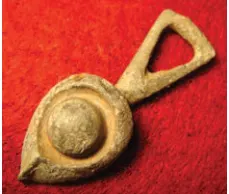
early example of a button and loop fastener, which is one of my favourite finds. These were used (probably) to act as a fastener for a cloak and made just before, and after, the Roman invasion, so date 1st century. There are variations on a theme, some looking a little like duffle coat fasteners, but this is one of which I am very fond. Note the “eye” design. It is hard not to think that this little object was functional and aesthetic, but also spiritual insofar as it kept away bad spirits for the vulnerable traveller. Objects can tell you so much!
Rings
Finger rings have been popular for 2,000 years. They are easily lost and, unsurprisingly, crop up every so often when metal detecting. Of those that come your way most will be modern, but potentially still interesting, and if beach detecting is your thing then you will find such rings quite regularly. Cold sea water makes fingers shrink and off slips the wedding ring. Snow has the same effect and I have been called out, in a blizzard, to help a damsel in distress find both her wedding and engagement rings. We found them, much to her delight! Gardening also takes its toll, and rings fall off when gloves are being removed. Of course, rings and fingers have been parting company throughout history and so, now and then, you might dig up a finger ring that is not at all modern. The Romans loved all sorts of what we might now call “bling”, and finger rings were popular. It is dangerous to talk of a standard design as these rings come in many different forms but there is a common profile that is easily recognised. They can appear quite chunky, with a rounded shape and, at the front, can become quite wide with a broad, elliptical stone inserted. Often this intaglio may have a figure carved in it, which may have been used as a form of signet ring (see Benet’s Artefacts - 2nd Ed pp177-195). Unlike medieval rings, they don’t often carry “modern” precious gems. The bronze example, right, has a missing intaglio but nicely shows the typical Roman shape. Mind you, some Roman rings seem to be more than decorative. For years rings with the inscription “ToT” have been turning up in Lincolnshire and the FLO there, a very

nice chap called Adam Daubney, has been making a study of them. The map shows their distribution, or at least it did until my detecting partner Nick Barrett found this one in Wiltshire! Anyway, Adam believes them to be a sort of devotional ring to a Celtic god “Totatis” worshipped by the Corieltauvi tribe in, what is now called, Lincolnshire. In 2001 only nine rings of this type were known but, thanks to metal detectorists, no less than 66 have now been recorded with the PAS and they are providing invaluable data for his research.

A rather different style of Roman ring symbolises rebirth and healing. The snake ring can be made of gold and be a high status item; however, this rather more humble example is made of copper alloy. Saxon and Viking rings do exist and perhaps you will be lucky enough to fi nd one - but it’s not likely so let’s move on to the medieval period! Any medieval, or Tudor, ring is a wonderful fi nd. Signet rings, for example, with a carved initial, allow you that personal connection with the original anonymous owner and you can imagine them being used to add a personal seal to wax. They are quite big and masculine looking as are iconographic rings (i.e. those with religious images, presumably worn by members of the clergy or by monks). But, for the most part, medieval rings are more delicate in appearance. Indeed, were it not for the obvious “handmade” quality about them, they look much like modern rings made for the female hand. They may also contain precious stones. Fede rings have a clasped hands motif. Their use was quite common throughout the later medieval period and into the 16th century (and I believe, even today). They were romantic in nature and vary from ornate gold or silver examples to rustic pewter forms. On the right is an early 16th century example from the rustic tradition. Made of debased silver, I found it shortly after starting the hobby. I remember that the landowner, a good friend of mine, described it as “something out of a Christmas cracker”! In the post medieval period mourning rings became popular. They are perhaps a little morbid to our taste as they were made after a person’s death and worn as a form of remembrance; indeed provision was often made in the will for their manufacture and distribution! They are usually inscribed on the outside with the initials of the deceased and even a date of death. They may have a black decoration. On a more cheerful note are posy rings, which are plain gold bands with a little romantic rhyme (the posy) engraved on the inside so it would only be known to the married couple (or lovers). Each year a handful of these go through the Treasure process and (remarkably) in 2007 I found one! The posy on mine reads “The Love is True that I O.U. x”; perhaps a little sickly by today’s

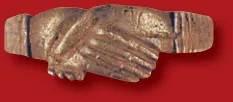

standards but there you have it. It was dated to the end of the 17th century and so (just) came into the Treasure category of over 300 years. As it is the only gold thing I have ever found I thought it deserved a picture!
Seals

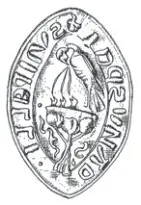
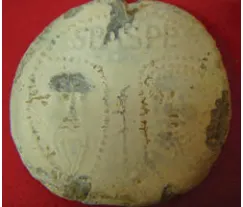
Some detectorists prefer to fi nd coins over artefacts, but artefacts are more personal and there can be few objects that connect you with the original owner more personally than seal matrices. Medieval matrices (the word “seal” can refer to either the matrix or the wax imprint) were used in a time where signatures were not common in a broadly illiterate age. The seals of royalty and the nobility were attached to ribbons hanging from the bottom of documents and were rather large. For everyone else, matrices were between 1-2cm in diameter and, depending on your importance (and probably budget), made of silver, bronze or lead (like that above). The better off had bespoke matrices, with an abbreviation of their name in Latin or French; those for more humble folk were generic and “off the shelf”. Like so many objects we fi nd, these seals have gone from being rarities in museums to relatively collectable items - all thanks to the numbers found, and recorded, by metal detectorists. If you are lucky enough to fi nd one of these then you are advised, by professional conservators, not to take a wax impression as the wax can remove small fragments of a fragile matrix. However, as this lovely bronze example I found is in excellent condition, I ignored the advice and took one anyway. It is probably 14th century and has a “fl eur de lys” emblem in the centre with the script around the edge reading, S. h DEPEChy. Chi, which means “seal of (sigillum) H. de Pechy of [possibly] Chippenham”. To be able to link an object with a named individual who lived 600 years ago is quite magical! This example is quite unusual, in being hexagonal at the base, as most examples of this period are round, but is otherwise typical of matrices with suspension loops sitting atop a stem. Slightly earlier, perhaps late 13th century, is the pointed oval matrix (called a vesica shape). They are a different design in that the suspension loop is at the top of a strengthening ridge on the reverse of the matrix and so the whole thing is quite fl at in appearance.

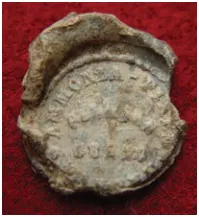
Fast forwarding to the 18th century, seals make a comeback, at least as finds. Georgian fob seals were highly fashionable for quite a long period. By this time the rise of the middle class had occurred and, unsurprisingly, these are much more common finds. Otherwise the parallels between these and their medieval counterparts are remarkable. Once again, at the top end of the market, they were highly decorative and made of solid gold or silver, but now had a separate centre piece, the intaglio, which had a bespoke family emblem or personal initials. Those of more humble stock had to be content with copper alloy and gilt with an intaglio which had an “off the shelf” design, just like their medieval forebears, often of some generic classical profile, like the one shown above. Of course, you will never find a wax seal in the ground, but you might find an imprint in lead. The most dramatic of these are papal bullae, lead imprints of the seal of the Pope to be found on all documents sent out from Rome to medieval Catholic countries which, pre-Reformation, included England and Scotland. Molten lead was poured over a cord, hanging from the document, and the impression made. Not quite such an impressive find, but still mildly interesting (especially as it was found on an otherwise miserable day), is the lead bag or bale seal, such as that shown on the right. This one is probably 19th century, although they can be older, and was probably used for bags of seeds or something similar.

Tokens
Not every round piece of metal is a coin! Most such finds are, of course, buttons, but even after you dismiss those there is another category of artefacts: the humble token. These are “coin-like objects” that,
if you are not careful can often fool you; but when you fi nd one (and you will) do not be disheartened, for they are often really interesting! Tokens, of one sort or another, have been around since the 14th century; but their appearance, scarcity and even function often changes. So let’s take a quick look at what you might dig up.
Jettons
Sometimes called “reckoning counters”, these were in use from the late medieval period through to the late 17th century. The early ones were made in England and then later, by the 15th century, often imported from France, many (not all) from the town of Tournai. They can be quite large, about the size of a pre decimal penny and often have French heraldic images. In good condition they can be quite beautiful although not particularly valuable Here is an elegant example dating from the late 15th century. By the 16th century the Germans seem to have cornered the market, and vast numbers were exported, from Nuremburg in particular. These are a little smaller and often have an “orb and cross” motif on one side. The German text will often tell you the maker although, on the reverse side, most have some fairly meaningless saying. This one was found in the front garden of an old mill, just the place where you would expect the trading of goods to be going on. It was made by Hans Krauwinckel in the late 16th century. So what were jettons used for during all this time? Well, the standard answer is that they have no face value, but instead were used by traders to do calculations. In an age without pencil or paper, a cloth would be produced with drawn horizontal lines, a bit like an abacus. A jetton, placed upon a certain line, would have a certain “value”. By moving them around, a trader could do all the sums necessary to work out a bill or to work out the change: all very clever! Usually they are found singly but, on a club day out some years ago, Stuart Bailey and Nigel Wright found a jetton hoard outside


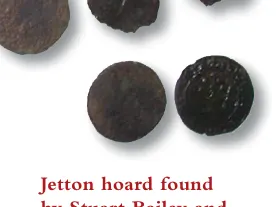
the entrance to a medieval church. Apparently it was not unusual for trading to take place just beyond consecrated ground! Details of the hoard can be found in the PAS report for 2005/6 (page 90). So many jettons are found in all manner of sites that some archaeologists speculate that perhaps they were, at least for periods, used as “small change” and it is entirely possible that over the centuries that they were in circulation that their practical use did alter. Some research is needed here.
Lead Tokens
Usually small and roughly made these quite distinctive objects are a bit of a mystery. The consensus is that they are late medieval (but that could easily stretch to the 17th century) and they might have been used as small change in a local market. But no one really
knows. These objects were clearly used by the common folk and the details of their lives were never well documented. Certain designs crop up regularly, such as the weave or the anchor, and there may be regional variation. Personally I think they are lovely objects and make a great fi nd.

17th Century Trade Tokens
Thankfully we know a little more about these! They were produced by local tradesmen as a response to a desperate shortage of low value coinage. They appeared for a brief period from the 1640s until the Crown started issuing offi cial copper coinage in 1672. In my (limited) experience most seem to date from the 1660s and are usually quite small, the size of a modern 1p piece, and have a face value of a farthing (¼d). The recording of these tokens, with the PAS, provides invaluable information about the geographical spread of trade at that time. Many of them have the merchant’s initials on them, as with the example on the right (in order: I, R, and surname V), along with the town of use (here, Colchester). A museum will often be able to identify these for you and you might even be able to fi nd something interesting about the specifi c tradesman.
Late 18th Century Tokens
Another crisis resulting from a lack of small change occurred in the reign of George III. The Crown stopped minting copper coins in 1775 and soon they were in short supply. The situation was made far worse by the coming of the Industrial Revolution and the consequent migration of people from rural villages to industrial towns. Workers needed to be paid and coinage was sparse. Eventually in 1787, a copper mining company in Anglesey took matters into their own hands and started minting tokens. Quite soon, others copied this idea and by the early 1790s there were so many different designs that, even at the time, they became collectors’ items! Fairly common detecting fi nds, they are generally bigger (½d size) than their 17th century cousins and, being machine made, look much more “modern” in quality. They often have elegant designs and were distributed over wide areas - not just locally. The druid image (right) is perhaps the best known of these tokens and was a symbol of the Celtic heritage of Anglesey, home of the Parys mine. Other tokens take images from the classical world and some even

have advertising. Once again, in time, the government acted and there was a recoinage in 1797 when the famous “cartwheel” pennies were minted. Tokens were yet again banned; even so, many of them appear worn when dug out of the ground and must have remained in circulation for years after.
Weights
Today, if you buy a bag of fl our, you assume that the weight on the packet is what you get; but it was not always so! A set of weights was essential if you were a trader dealing in loose produce and, because your customer probably thinks you’re trying to pull a fast one, he will want to see an offi cial stamp on your weight to confi rm it is the weight it states. In return, the trader might want to check the weight of your coin to make sure you weren’t trying to pass off some counterfeit or clipped coin. So here are a few examples that we have found.
Steelyard Weight
A steelyard was a portable device that allowed the trader to move weights along a bar and get them to act as counterweights for whatever was being measured. The Romans used them all the time, but they proved so useful that they remained in use right through the medieval period and well beyond. This is Micky’s sketch of a Roman steelyard which is on display in the British Museum. You can see how it would have been suspended by the hook on the top, and the “claw” on the bottom right would have had a pan hanging down from it. The weight on the left is moveable so as to counterbalance whatever was in the pan. The example shown on right is one of several found on a particular Roman site. It is a crude lump of lead, with a slightly “pear-shaped” profi le with an iron attaching loop (broken) on the top. It is over 4cm long and piles in at a hefty 125g or so. They do come in different sizes. A detecting partner of mine Nick Barrett and I have found a complete set of these on the
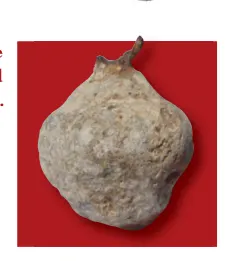
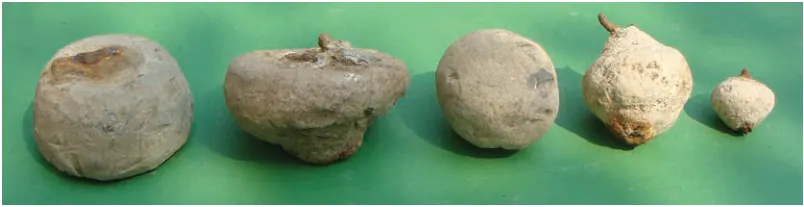
site (shown above), and if ever you wanted evidence of trading at a particular location then this is surely it! It just goes to show that even an ugly lump of lead can give you a valuable insight into the past. Interestingly the 125g weight is the second lightest of the set, so they were weighing out substantial amounts! Not all Roman weights were as simply made, and they can be quite sophisticated in shape. If you are very lucky you may fi nd one in the shape of a human, divine (god/goddess) or even an animal bust. Medieval steelyard weights also vary considerably. On right is (I’m pretty sure) a medieval steelyard weight, although I wouldn’t begin to give it a more precise date. It has a lead suspension loop and the base has been made into an angular shape - all very different from its Roman ancestor. The downmarket ones are still better made than the crude Roman lump and the upmarket ones can have heraldic emblems on them - like that illustrated right - and might well have been made of bronze. Of course, you might always unearth the steelyard itself - but that would be a fantastic fi nd!
Trade Weights
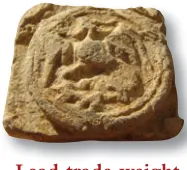
Trade weights served a similar function to the steelyard weight. These were used on simple sets of scales and, as they had to lie fl at and not hung, they are a very different shape. Post medieval (18th century) trade weights are typically round and fl at with the earlier ones made of lead (often hard to date as they have no markings). By and large, the later ones are of brass. This one has stamps all over the place and seems to have been, unhelpfully, over-stamped with a ¼lb mark. Often the stamps are clearer and they can tell you quite a lot. The monarch might well be shown as a crown with an abbreviation beneath; so a crown with VR or GIII would show Victoria or George III. This was important as it meant that

the accuracy of the weight was backed by the authority of the state and you messed with that at your peril! Another common mark is a large A, which stands for “Avoirdupois”. In the medieval period there were, confusingly, two systems of weight in operation: Troy ounces and Avoirdupois ounces, and these differed from each other. Over time Troy ounces went out of use (apart from with precious metals where they are still used today) and a local market would only see Avoirdupois trade weights. Some weights also show “hallmarks” and one of the most common is a sword, indicating London. For anything else - enjoy your research! Some earlier medieval trade weights were not circular but often made into rather crude shields with heraldic images (illustrated right). They often have holes in them presumably to string them together.
Coin Weights
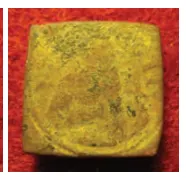
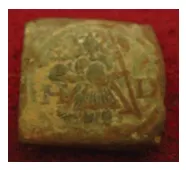
On the right are two photographs of a coin weight of James I. These are often (not always!) square and are made to match the exact weight of a particular gold coin. The value of that coin might be found on the obverse and a similar image to that found on the coin itself, might be found on the reverse - useful when such coins were so rare. This one is for a gold coin called a “unite”, worth 22 (XXII) shillings. You can just about make out the king, with orb and sceptre on the reverse which matches the real coin. The whole point was to discourage counterfeiting of coins and also the “clipping” of the edges of hammered coins. A merchant would have a boxed set of coin weights and use them to check the weight of high value coins offered to him in trade. Throughout the medieval and post medieval periods foreign coins would be circulating and so you come across weights for these too, or at least the high value ones. Many of these were made in Antwerp, and always carry a motif of a fl at hand. This Antwerp weight, found in Wiltshire, was designed to counterbalance a Hungarian ducat (hence “HD”). European trade is nothing new and by recording fi nds such as these, with the PAS, you will add to our understanding of how that trade worked.
Loom Weights & Spindle Whorls
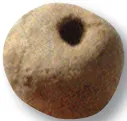
A spindle whorl is a plain, ringed doughnut-shaped lead object used for teasing out the fi bres of wool to make yarn. Sometimes they are decorated with dots and triangles but more often not. They were used to create the tension to allow the yarn to wrap around the “drop” spindle. Now I know you didn’t take up the hobby of metal detecting to learn about textile manufacture but I include this little diagram of how it’s supposed to work for your self improvement. Then there are loom weights, a term often, wrongly, interchanged with spindle whorl. These were used, in a certain type of vertical loom, and in the illustration below, drawn by Dianne Leahy and kindly provided by her and Kevin Leahy, you can see the weights hanging down at the bottom to pull down various yarns in the weaving process. It is likely that most of these were quite a bit bigger than the spindle whorls but, to be honest, I think they used any old lump of lead, stone or ceramic around so the shape may not be an accurate guide to their use.
“Prehistoric” Artefacts
What we mean by “prehistoric” is the time before written records and before history, and for us in Britain that means pre- Roman. Archaeologists break the term down further into different “ages”, depending on what materials were being used at the time, and it is worth having a look at this if, for no other reason, than we will know what the experts are talking about!
Palaeolithic .......500,000-12,000 BC ......Ice Ages, mammoths!
Mesolithic ..........2,000-4,000 BC ..............Hunter-gatherers in forests
Neolithic ............4,000-2 000 BC ..............Farming!
Bronze Age .......2,000-800 BC ...................Bronze axes, spears
Iron Age ..............800 BC-AD 43 ...............Coins, trade with Rome
Palaeolithic (meaning “old stone age”) refers to the period since the arrival of human species to Europe and the vast ocean of time when they survived the ebbs and flows of various Ice Ages. For most of this period, from about 500,000 years ago, these were not even modern humans but our evolutionary cousins, the Neanderthals. We, Homo Sapiens, evolved in Africa about 200,000 years ago and there we stayed, geographically trapped, until a few hundred individuals (yes, all non-Africans on the entire planet are descended from this small group) managed to migrate perhaps 80,000 years ago. “We” arrived in Northern Europe only about 45,000 years ago bringing our stone tools, art, and way of life; hunting and utilising herds of wild animals in the cold environment. There is no pottery, no metal artefacts, and evidence of any kind is rare indeed. You will not find any! With the retreat of the glaciers, about 12,000 years ago, and the rise of the sea level, Britain and Ireland slowly began to become separate from the European mainland and become islands. They were forested and the people were “hunter gatherers”. They were transient, hunted deer and game, but also relied on plants and increasingly had temporary seasonal bases to which they might return year on year. This was the Mesolithic era (“middle stone age”), and the entire population of Britain may have been merely a couple of thousand people or so - you might rarely encounter anybody outside your extended family! That is quite a thought, and the whole subject is fascinating, but still not of any direct relevance to a metal detectorist!
In our hobby we should start to pay attention in the Neolithic (“new stone age”). This is when the idea of farming arrived at our shores about 4000 BC (about 6,000 years ago) having spread from, what is now, Iran. Farming changed everything. People now stayed with their crops and were no longer always on the move. Surplus food could be grown and populations increase. Innovation could occur, like pottery, and society could support specialists like priests. This was when monuments started to be built: long barrows, early stone circles, and the like. Apart from the rare bit of gold there is still no metal, but the use of fl int became prolifi c. Eyes only fi nds are inevitable when, as a detectorist, you spend hours staring at the ground, and it is well worth learning to recognise the distinctive design of Neolithic pottery and even the signs of worked fl int. This is a Neolithic fl int axe head I found just lying on the surface. It may be a bit battered, but it is about 5,000 years old and just shows why you should never detect too fast! Very occasionally highly polished ceremonial axe heads are found from this period. Neolithic pottery looks pretty crude to the modern eye. It was used for domestic storage, and was thick with rounded bottoms and sometimes decorated with bits of cord or with dots around the rim. The potters’ wheel had yet to be invented so it was made by coiling a long “sausage” of clay and then fi ring the pot on an open fi re, which supplied a fairly low temperature. Such pots must have broken very easily. Bronze is an alloy of copper with a little tin. The tin strengthens the metal crystal making it much more hard wearing and much more useful than copper alone. Most of Europe started with a “Copper Age” and only later moved to bronze but, thanks to all that accessible Cornish tin, we bypassed that and the Bronze Age started in Britain about 2,000 BC. The thing is that at the same time, everything else changed too. The elite were now buried, with grave goods, in round barrows; pottery became more sophisticated, and the evidence is compelling that society became much more hierarchical and complex. Archaeologists argue heatedly about whether all this represents a migration of new people (sometimes called the “Beaker People”) or simply a migration of new ideas coming from Europe. That debate is not for the likes of us but at last we can now fi nd metal objects!


Shown above is a beautiful middle Bronze Age palstave type axe head that Nick Barrett found sitting on the top of a field! A pound coin is shown for scale. Objects such as these, which required great skill to make, seemed to have a use beyond that of the merely practical and, in the later Bronze Age, became a sort of early currency - a way to store your wealth and display your status. The drawing above right shows the more common loop and socketed axe style and if you are really lucky you might even come across a socketed spearhead! Bronze Age pottery is far more sophisticated than Neolithic. The iconic form is the “beaker”, a tall, elegant, slightly-curved vessel with high decoration, a flat bottom and thin walls (see right). Always keep an eye out for an unusual decorated shard and, if you find one, record it with your FLO in the usual way. In the late Bronze Age large hoards of axe heads and ingots, containing sometimes hundreds of items, often never used, are buried and hence discovered by detectorists. Why they were buried is a hot archaeological topic, but it could be a symptom of an economic collapse, perhaps caused by the discovery of a new “wonder” metal, iron. The Iron Age arrived in Western Europe at about 800 BC. There is a much wider array of objects that you might stumble across with your detector and, although none are exactly common, they do turn up from time to time. Of course, bronze - being pretty and not susceptible to rusting - was still the preferred metal for decorative
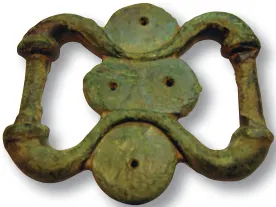
objects. In brooches and fasteners, sometimes with colourful glass enamel, can be seen a variety of stylised swirls and abstract patterns. Celtic art was very different from the realistic representation on later Roman objects. The illustration (right) is of a strap junction, probably from a horse harness. Also, have a look at those Celtic coins, looked at earlier, to see what I mean. A guide like Benet’s Artefacts is an excellent starting point to see what might be found!
Miscellaneous Bells Oddly, I once went through a period of fi nding bicycle bells in the middle of fi elds. They were recovered on different farms on different days but there they were, being pulled out of the ground on a regular basis. I must have found half a dozen in as many months, and I haven’t found any since (not that I’m upset). There is no pattern in what we fi nd! More sensibly you may fi nd crotal bells, small bells that hung from various farm animals such as sheep or shire horses. Or, I should say, at least in my neck of the woods you will fi nd them, as in southern England they are quite common fi nds; but not for you Northerners and Scots. I presume it was a question of fashion, and I really don’t know where the limit of these bells is to be found but there it is. They appear in the early post medieval period, seem to reach their heyday in the 18th century, and then gradually fade away from history. They are spherical, with a suspension loop and two sound holes in the upper half with an iron ball inside. The bottom hemisphere, by the 18th century, was often decorated with a fl owering petal design and sometimes had the maker’s initials. With a little research, these makers can sometimes be identifi ed. Finding one that still rings is always a pleasure, although fragments are more common. Of the two bells on the right, the (considerably) larger one has a clear “RW” on the bottom. This is “Robert Wells”, who had a bell foundry in the Wiltshire village of Aldbourne in the 18th century. The smaller bell has “RN” as the maker and I have failed to identify this. If you know, please tell me!
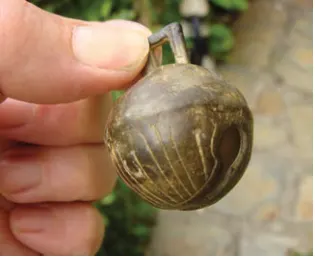
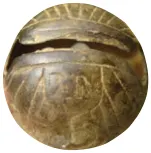
Bells with an integrated suspension loop (i.e. where they have been cast out of the same piece of metal and the hole simply drilled through), are thought to be older than those which have a square frame attached. For that matter, if you dig up a bell decorated with fish then that is likely to be a 17th century example.

Pot Mends Like most new to the hobby I had no idea at all what this odd lead thing was when I first dug one up. They are from a “lost age” when things of value were mended rather than replaced When a ceramic pot became damaged with a small hole in the bottom then the “mend” was to pour a little molten lead into the hole and allow it to solidify above and below. The now sealed hole would be fine until the pot eventually broke and was discarded. The pot mend would now look like a lead sandwich with, if you are lucky, a little ceramic left between. I’ve even got one with an imprint of the cloth upon which the pot was resting when it was fixed!
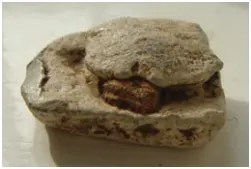
Swords & Daggers The Bronze Age apart, the blades of swords and daggers are made of steel and, even if they do survive rusting away in the ground, you will miss them if you are using discrimination on your detector. However, that is not true for the “accessories” and the bits and pieces associated with them vary in substance and style over the centuries. Pommels are the tops of the “handle” and are pretty rare things. Well okay, that is unless you were the finder of the Staffordshire Hoard, which contained several dozen Saxon examples decorated with gold! At the other end of the scabbard is the chape. Its job is to hold the point of the blade, and when the leather of the scabbard rots away then the chape may well be all that survives in the ground. As swords are


larger than daggers, they can vary in size and in decoration, from the highly ornate to the plain, as shown here in the photograph. Its simplicity makes it hard to date, but it is likely to be late medieval or early post medieval. You can see a small hole (top right) where the leather would have been attached. A more likely fi nd is a Tudor sword hanger, or at least part of one, like that on the right. This one is only half complete but the top bar would have been fastened to the belt, and the two (or often three) hangers would have fastened to the top of the scabbard. This would give lots of fl exibility in movement for the sword. They are often decorated (oddly) with botanical designs.

Thimbles Until you start detecting you would have no idea how common thimbles are, of all ages, in our fi elds. I suppose it is a comment on the “make and mend” way of thinking of our forebears, and the stark reality of poverty, that you made instant repairs on your clothes when doing hard physical work. That said, some thimbles are clearly items of status. The top one shown is called a “beehive” thimble. It could be between the 15th and 16th centuries in date and you can see how the dimples were all handmade and spiral out from the apex. I never thought I would ever get excited about a thimble but it really is a lovely thing. It seems there are a lot of thimble collectors out there, and examples in excellent condition are surprisingly valuable! The middle is a little later in date, probably 17th century, and is solid silver. The third, also silver, is later still, (19th century).


Other Roman Artefacts Roman society was sophisticated, hierarchical and survived on the wealth produced by trade. Consumer goods were produced in enormous quantities, both locally and throughout the Empire and the desire to own “stuff” was much more like our own world than the early medieval period that followed. So the variety of Roman artefacts that can be found is wide and fascinating. As always I cannot be exhaustive but it is worth looking at a few, fairly random, examples of what might just turn up.
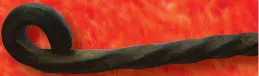
Here is a piece of Roman armour. Well, I say that as it was originally identifi ed as such but it is, apparently, an object without parallel and now our FLO thinks it may be Saxon! In any event, it is rectangular with two suspension loops at the top, and an attachment lug at the back. I have told the club member who found this that I think it is the most beautiful metal detecting artefact I have ever seen! The cartoon face is utterly modern and has an expression that is hard to pin down but reminds me a little of the expressions on the Lewis chessmen in the British Museum. I absolutely love it! The Romans produced all sorts of little instruments made for specifi c purposes. Some of these were medical and others were cosmetic in nature. A Roman gentleman might carry a metal ring to which would be attached several of these things, including, perhaps, some tweezers, a toothpick, ear scoop, and even a device for smartening up your nail cuticles (can’t say I have one of these myself), like that shown. It is about 10cm long, is of twisted copper-alloy wire and is very hard to photograph properly! One end has an attachment loop and the other is fl attened out. Some more experienced detectorists will complain that there is no separate section on keys. Well there isn’t, but as a peace offering here is a 14cm long Roman example. Perhaps this object, more than any other, represents the modernity that the Romans brought to these islands. Spirituality was central to all aspects of Roman life. A wide range of gods were seen to intervene directly and regularly on a daily basis and so many fi nds relate to this. This is a stunning example of a statuette (this is about 6cm high), which would probably have been carried around and used as a focus to prayer. On a related note, you might come across Roman objects that seem to have been deliberately been broken and put beyond use.



These are called votive offerings, and another example is this lovely miniature cauldron found by Nick Barrett. Also found by Nick is a rather fi ne Roman decorative pin.

Roman Pottery This is not a book on ceramics, but we ought to say just a little about Roman pottery as, if you start to fi nd Roman metal objects, you will undoubtedly come across shards aplenty! For those of you who want to learn more about this I would direct you to the Further Reading secton at the back of the book. The most “posh” form, and the easiest to recognise, is called samian ware.This was used for tableware and has a distinctive and rich iron red colour, with a shiny surface fi nish. It was produced, mainly in Gaul, in huge quantities and exported to wealthy homes across the Empire. Some examples were highly decorated, although many were relatively plain. If you are lucky you might fi nd a maker’s stamp on the base. The piece on the left has DVPIVSF and the fi nal F stands for fecit (made); so, in effect, “made by Dupius”. Amphorae, by contrast, were huge thick storage containers that may have contained wine, oil or anything imported into provincial Britain. Below are some complete ones, in the British Museum, and a broken handle piece, which is more the sort of thing that you might fi nd!


Roman amphorae in the British Museum.
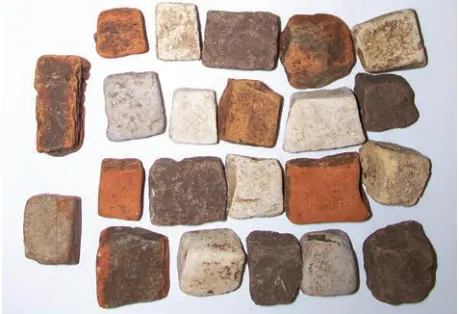
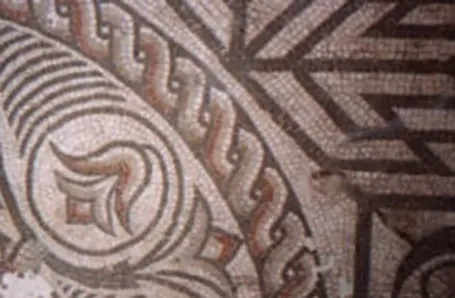
Kitchenware, at least in Britain, is dominated by, what is called, black burnished ware, which can be black or grey and quite be quite dumpy in appearance. Mosaic floors were a luxury that only the well-off Romans or Romanised Celtic leaders could afford. Single pieces of tesserae were hand cut from different types of stone and pottery, roughly cubic in shape, so that Roman artisans could make patterns from the different colours to create a fantastic patterned picture on the floor of a villa. These tesserae are usually found near the site of a Roman building or, just perhaps, where a bag has split that was being transported to a building site. Here, on the right, is a typical example of a mosaic showing part of a rope pattern encircling a series of flowers. The use of solitary tessera can be clearly seen to make up the desired shapes. Each piece was set in cement to form the pattern to a laid out plan. One square foot of flooring takes about 140-150 tesserae, so a room 15 by 20 feet big would take 40,000- 45,000 pieces; and this is based on quite a large cube. If it was set with smaller pieces, to give a more detailed appearance, this count could rise to twice the number and could weigh in excess of a ton. Their abstract artwork also included people, animals and/or scenes from mythology.
Lead Bits & Pieces An archaeologist once described lead to me as the “silly putty” of the ancient world, and I know exactly what he meant. It is soft, malleable and has a low melting point, all of which means that it has always had a multitude of uses. Some fields seem to be full of small pieces of scrap lead and they too give a great, heart racing, signal.

But turn adversity to advantage! For some years our club has been collecting the scrap lead found by members and selling it off to a dealer. It’s not a fortune, but we annually raise about £50 for charity and it means that we feel a little better about pulling a chunk of lead from the ground. One level up on the scale of desirable finds (but still pretty low) we come to the objects that come out of the gun. Personally I quite like lead musket balls and, as you can see, they come in different sizes. You often come across one that has impacted and has a flattened edge. Lead bullets of 19th century date, designed for rifles, will impress most farmers (no, really, they will) and then you get the 20th century copper-alloy bullets. I have kept a small collection of these
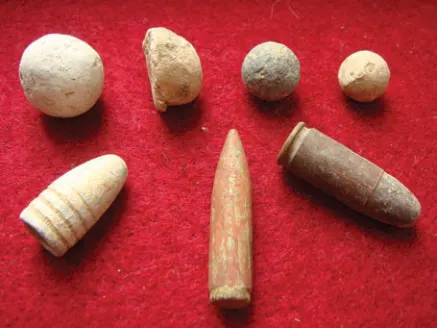
things and, when our club display finds at Young Farmers events, I always put them out. The real farmers go straight past the Roman brooches, pay scant attention to the medieval hammered coins but zoom in on the collection of bullets and shell cases! The Golden Rule of rubbish is: never assume that it is rubbish until you have got home, examined the object thoroughly, and you are absolutely sure. This is particularly true when starting out on the hobby, as you will simply not recognise artefacts for what they are. If in doubt, ask your FLO or an experienced detectorist (whose judgement you trust!). Many of us have tales of throwing something away which we later realised should have been kept and recorded! Finally, remember to pick up items that you can find by just using your eyes as you walk across the fields. This is always better after rain, as the dirt is washed off and the items are normally shiny. The archaeologists call this “fieldwalking” and we do it as a matter of course. This is always better on ploughed land, but items do show up in grass fields from where the moles, badgers and foxes disturb the soil and leave it on top. Neolithic flint arrow heads and scrapers are regularly found on the surface. You might even find bits of tiles from the Dissolution of the Monasteries that occurred in the 1500s. Also to be found is glass from Roman to the present day, and fossils which can date to about 450 million years ago! Who knows what you might find?!
Recording Finds
The whole point of recording your finds is illustrated here with the information already being used from the Frome Hoard, as talked about by Sam Moorhead from the British Museum. “With 52,503 coins, the Frome Hoard is exceptional by any standards. However, it is also enormously important because Dave (Crisp) enabled us to excavate the hoard professionally, and because it contains the largest group of Carausian coins ever found together. When all the illegible coins have been conserved, we expect to have around 800 coins of Carausius (AD 286-93). “Carausius came from Menapia, the region around the mouth of the River Rhine. After an early career as a sailor, he rose through the ranks to become a senior general in Germany and Gaul under the emperor Maximian (AD 286-310). Carausius was tasked with commanding the Roman fleet in the North Sea so as to combat the increasing threat from Germanic pirates who were probably

attacking not only Roman settlements on the coast and near major rivers, but also fleets of Roman supply ships which transported grain and other goods from Britain to the Continent. History tells us that Carausius waited for the pirates to attack and then took their booty off them without giving it back to its original owners; for this, Maximian sentenced Carausius to death around the year AD 286. “Carausius, however, escaped capture and was probably made emperor at Rouen in Northern France where his first coins were struck. So far, one of his Rouen coins has been identified in the hoard. From Rouen, Carausius moved to Britain which became the core of his empire - he probably also held some coastal territory in Gaul. His arrival in Britain is celebrated on two silver denarii in the Frome Hoard: one shows Britannia greeting Carausius with an inscription from the Roman writer Virgil - ‘Welcome, O longawaited one’; the other coin shows Carausius riding into London with the inscription proclaiming his arrival ‘ADVENTUS’. “There are five silver denarii of Carausius in the hoard, the largest number ever found in a single find; I only know of just over 300 denarii of Carausius in existence. On one of the other coins, Carausius proclaims that he is the ‘Renewer of Rome’ around an image
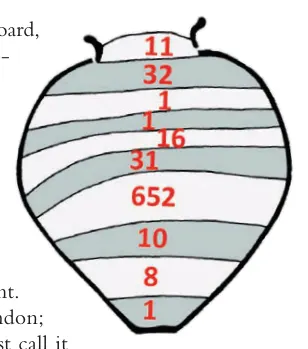
of the wolf suckling Romulus and Remus. The Frome Hoard, therefore, provides a wonderful insight into Carausius’ propaganda campaign. “All the other pieces in the hoard are bronze ‘radiates’, some still retaining their silver wash. There are a large number of early coins which do not have mintmarks. These pieces vary enormously in quality, some being of good workmanship, others being very crude. One would expect such variety because Carausius had to set up his mints in Britain from scratch and would not have had access to any official mint staff from the continent. There were two mints in Britain: we know one was at London; the other struck coins marked with a C or G and we just call it ‘C’ Mint. “As yet, we do not know where ‘C’ Mint was, but I will be presenting some new thoughts on this when I publish the new Roman Imperial Coinage volume for Carausius and Allectus. However, because we were able to excavate the Frome Hoard by layers, I know that there were two separate groups of Carausian coins The larger group consists of the later coins; they were tipped into the pot about halfway through the process. However, a smaller group of earlier coins, including the silver denarii, were present in the last batch of coins to be added to the hoard; they were found right at the top of the pot. This group has a significant number of early London mint coins marked ML (‘Moneta Londiniensis’), but no coins from the ‘C Mint’; there are many coins marked with ‘C’ in the main group of Carausian coins further down the pot. This does appear finally to confirm that London started to mark its coins before ‘C Mint’. Amongst the early London coins are some struck to honour the legions which assisted Carausius: one for Legio XX at Chester has its legionary mascot the boar. The majority of the other coins are London coins marked with F O and B E, the latest pieces dating to around AD 290/1 when Carausius repelled an invasion by Maximian - this was the first time ever that a British navy was used to defend our shores. Research into the latest coins is on-going, but it does seem that it will shed light on the possible nature of ‘C’ Mint “Amongst the Carausian coins there are a number of new varieties that have not been recorded before. Because it took a while to establish proper quality control in Carausius’ mints, there are numerous differences in details and a large number of mistakes - whereas most emperors at the time had around ten to fifteen different
versions of the imperial title, Carausius had over a hundred! The Frome Hoard is therefore helping us to define more clearly one of the most complex coinages ever struck in the ancient world; undoubtedly more secrets will be unveiled in the coming years.”
Coins of Carausius in the Frome Hoard Sam Moorhead (Dept. of Portable Antiquities and Treasure, the British Museum) May 24, 2012
“Chance finds made by members of the public have always formed an important part in advancing our knowledge of the past. The advent of the Portable Antiquities Scheme and the Treasure Act has seen a dramatic increase in the number of reported discoveries; hence chance finds form an ever more important part in our understanding of the past. Finds of treasure often receive considerable media coverage but less glamorous finds such as pottery sherds, flints and coins all have a very important contribution to make. Details of many of these finds are uploaded onto the Portable Antiquities website. This is very important, but there is always potential for finds to reveal more as new lines of research are pursued. The donation of finds to museums is to be encouraged, making them available for future research and study. It is very important that significant discoveries are investigated archaeologically, particularly if they are in, or come from, an undisturbed context. There have been a number of instances in Somerset that underline the importance of taking this approach. One of the best examples is the 1998 Shapwick Hoard of 9238 denarii which, upon investigation, proved to have been buried below the floor of a room in a previously unrecorded Roman villa. The Frome Hoard is another classic example of best practice with finder, landowners, archaeologists, coin specialists, conservators and museum curators all working, closely and openly, together in the interest of gaining as much information as possible. As this is being written, detailed work on the study of the Frome Hoard coins is still at a relatively early stage but the benefits of the controlled excavation and retrieval of the coins is apparent, both from the point of view of understanding the circumstances surrounding the hoard’s burial and of the placing of the coins in the pot. Much more will be learned as the work progresses.”
Steve Minnitt (Head of the Museum of Somerset)