11. Portable Antiquities and Treasure
Pages 118–124
Detectorists keep saying that their hobby is the best of them all. Well, I suppose advocates of windsurfing, stamp collecting, and gardening all say the same about what they do! Yet, in one way, detecting truly does have an extra dimension compared with anything else and that is because as well as collecting what we find we have the option to record it too. The act of recording your finds means that you personally are contributing to saving Britain’s heritage and helping the experts understand the lives of our ancestors. All of us involved in this book think that is rather magical! Perhaps we should start with the bit that is not optional! In 1996 the law which defined “Treasure” in England and Wales, was changed, replacing one that could be traced back to the 12th century! It now refers to objects, over 300 years old, which contain 10% silver or gold or other archaeological objects found alongside such an item. It was later amended to include prehistoric hoards. Single coins were omitted but two or more coins, thought to have been originally together, do count, even if the plough has subsequently pushed them apart! A full up to date definition is given in the appendices. If you find an item that you suspect might be classified as Treasure then you are under a legal obligation to inform the local coroner, although telling your FLO will do just as well as they can pass on the information. The idea behind the law is a
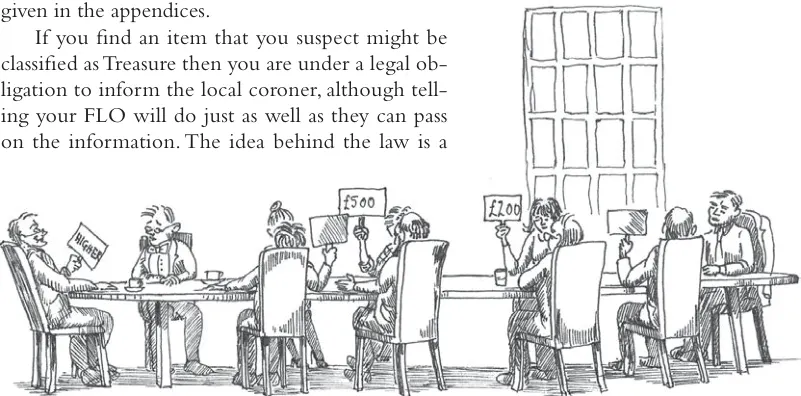
sensible one (i.e. to save for the nation the most significant, and precious objects, found by the public). Any suspected Treasure item is sent to the BM (or the National Museum of Wales) for examination. If they consider it Treasure then a Coroner’s hearing has to “rubber stamp” their view and then the item appears before the Treasure Valuation Committee (TVC), a group of independent experts who meet in the BM to put a market value on an object. Once a value has been agreed between the TVC, the finder and the landowner, then museums have the right to buy the object at this price and have some months to find the money. However, museums may disclaim the object because they don’t want it (or perhaps can’t raise the money) and it is then returned to the finder. The valuations are usually fair (disputes do happen but there is an appeals process) and the system, on the whole, works well. However, it can be very slow (sometimes as much as a couple of years or so) and this is partly because items that qualify as Treasure but are clearly not of the quality to interest a museum clog up the process. The other problems are the need for local hearings (there has been talk of the BM getting a dedicated Treasure Coroner to speed things up) and the sheer success of the scheme! The graph shows how the number of Treasure cases, each year, has dramatically grown - it is a victim of its own success! Objects that are not Treasure, yet are still over 300 years old, come under the umbrella of the Portable Antiquities Scheme (PAS). There is no legal obligation to do anything with your finds but the moral case is overwhelming. It all started in 1997 with six pilot schemes where detectorists were encouraged to record objects with archaeologists and, in 2003, the project went national. Today, the scheme funds the work of about 40 Finds Liaison Officers (FLOs) and, behind the scenes, about half a dozen National Finds Advisers. Each of the FLOs is a qualified archaeologist who has had specialist finds training. Their job is to visit metal detecting clubs in their county and record finds as well as deal with independent detectorists and general members of the public who may pop into local museums with unidentified objects. “Probably the most important aspect of the FLO’s job (and the one I certainly enjoy the most!) is identifying and recording the huge variety of
objects discovered by metal detectorists. One minute it may be an ‘eyes only’ prehistoric flint tool and the next, a Roman coin, medieval buckle or early medieval (Anglo-Saxon) dress accessory. Whatever the object, it is important that we record it in as much detail as we possibly can so this information can be saved on our online database (finds.org.uk/database) for all to see and use. This means, in the very least, we take measurements, weight and a photograph; but almost as important as the object itself is knowing where it came from, and we ask finders to provide us with precise and accurate find spots (which the general public will not see more precisely than a four-figure grid reference or 1km square). This creates an ever-growing map of information across England and Wales.” Katie Hinds, Wiltshire Finds Liaison Officer
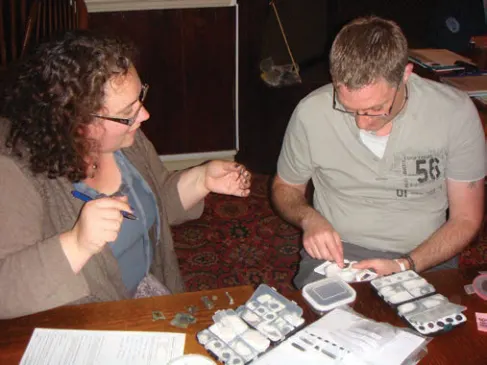
The photograph shows our Wiltshire FLO, Katie Hinds, dealing with a club member at one of our meetings. She takes into her care all the finds (giving receipts!) and, two months later, returns them with a written report on each. FLOs also attend rallies, give talks, visit schools and, increasingly, arrange for detectorists to help on archaeological digs in the area. The one thing they don’t do is give valuations. It is not part of their job; they are not interested in the value, and they probably don’t have the foggiest anyway. The Finds Advisers provide expert backup to the FLOs. Each has their own area of expertise and, they too, act as an interface between detectorists and academic archaeologists. The PAS exists, according to Roger Bland, Head of the PAS at the British Museum,“to minimise the loss of our heritage caused by the failure to record systematically objects found by the public.” The crowning glory of the PAS is the database at finds.org.uk and this should become one of your favourite websites! The number of objects recorded is pushing one million and is going up by about 100,000 every year and, of these, about 90% have been found by detectorists. The database was revamped in 2010 and this
has made it much more user friendly, particularly as most entries now have attached images. Anyone can access this material, although precise find location is deliberately withheld from the general public; and it can be fascinating looking at similar objects to those that you have just found yourself! So why should you, the new detectorist, bother with all of this? Because, while the ownership of the object itself is shared between you and the landowner, the information it can tell us is part of our heritage - it belongs to all of us. Removing objects from the ground and then keeping quiet about them destroys that heritage; it reduces the story of who we are and where we have come from - a sort of cultural theft. “A major survey of metal detecting, in 1995, found only eleven Bronze Age references. By 2008 there were 6683 in East Anglia alone!” - Nisha Doshi, University of Cambridge Master’s Thesis. Yet this only works if the academics can make use of all this material and add to the story of these islands. Is the PAS really helping with this? The short answer is “Yes!”, and that this is really taking off. On the PAS website there is a summary of the number of academic research projects currently directly using the PAS database. The numbers are increasing every year and, at the time of writing, they are 62 PhD projects and 85 MA projects. This must represent a high proportion of all the research being done in the UK and can only mean that the effort of recording finds is really making a significant difference to our knowledge of the past! So why is the database proving so popular? For the older generation of archaeologists it has taken a while to get past the suspicions of working closely with detectorists, but that is fading and they are waking up to the wonderful resource that the database provides. There has also been an inevitable time lag, in that the database becomes increasingly useful as it gets bigger and the statistics it provides become more reliable. For example by 2010, and in Lincolnshire alone, 175 new archaeological sites had been discovered because of finds recorded with the PAS. Better still, for the younger generation it is becoming the most natural thing in the world to get help from detectorists and the database is simply invaluable. A PhD student who makes use of our recording now will think favourably of the hobby for the rest of their professional career! Sam Moorhead, National Finds Adviser for the PAS says, “Across Britain, the PAS records are identifying large, poorly defined rural [Roman] settlements which have previously lain undetected.” He believes
that the recording of Roman coins by detectorists is transforming our understanding of Roman Britain. Archaeological digs have always focussed on high status villas or military forts, yet the PAS gives on rural sites which have been badly under-represented before now. He is insistent that we should even record our “grots” as these can help give a more accurate picture of coin use across the period. Anyone who uses a metal detector in England and Wales has access to a unique resource - the Portable Antiquities Scheme - to help them record their finds and thus add to our understanding of our past. This has helped to break down the barriers between metal detecting and archaeology that existed before the Scheme started in 1997. As Roger Bland informs us, in 2006 a Code of Practice on Responsible Metal Detecting in England and Wales which was endorsed by both the national detecting bodies and all the leading archaeological bodies provided a clear set of guidelines for detector users to follow Code of Practice The Scheme was founded to record archaeological objects found by members of the public in England and Wales, and has had national coverage since 2003. There is a network of 40 locallybased Finds Liaison Officers, 5 National Finds Advisers and 4 other staff based at the British Museum (details of your local FLO can be found at PAS Contacts). In addition to recording finds, the FLOs play an important role in helping finders report their finds under the Treasure Act and in advising them on the process. Neither the PAS nor the 1996 Treasure Act applies in Scotland or Northern Ireland however regrettable that might be. In Scotland any objects can be claimed by the Crown under the law of bona vacantia. I do not have any experience of how this works in practice but more information can be found at Treasure Trove Scotland In Northern Ireland the situation is different again and, unless you have a licence, it is an offence to excavate land searching for archaeological objects.
Treasure Valuation Committee
I have personally been through the Treasure process four times before my finding of a Roman hoard (described later). As I have stated before, I am fully convinced that it is a fair system. Back in
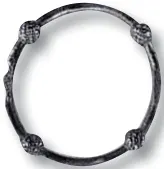
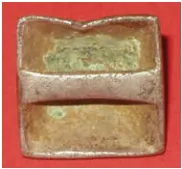
the old days I was at a rally down in Essex when I found a very nice medieval (13th-14th century) silver annular brooch. As the inquest was about a hundred miles away, I conducted it by post and it was straight forward Treasure. The valuation came in initially as a bit low so I thought I would challenge it, and the fi nal price came back a little more. Maybe it was my challenge, or maybe they just thought the initial price was a bit low. Then, in 2005, I found a very nice Saxon (or should that be early medieval) silver pyramidal mount, down in Somerset. I have to say I was not sure what it was until one of the members said there was a picture of one in the Treasure Reports. This was a slightly later, Anglo- Saxon version (6th-7th century) as it has a bar across the bottom for a strap which stopped his knife falling out of his sheath. It’s believed they were just a fashion accessory - a bit like “bling” is today. A few years ago I was also very lucky to fi nd two Roman silver rings in the same week in Wiltshire. One was quite plain but the other had a nice orange carnelian stone in it with a picture of a bird sitting on a branch This ring came to a sad ending. It had a bad kink in it, where the plough must have hit it one year. But the ring was full of dirt, and as I gently removed the dirt under the tap a piece of the ring fell out. Remember the old maxim: if in doubt leave it alone. But all was not lost I had saved the bits, but this must have affected the value from the TVC. The British Museum still wanted it for their collection. (Why I don’t know). I did mention by letter that all it needed was a bit of soldering, maybe they did get it fi xed. There are exceptions to the rule, like the Crosby Roman cavalry helmet sold at Christies for £2.3 million but there is always


somebody who is willing to pay over the odds for a unique item. This was estimated by Christies at £200,000 to £300,000 . It’s like a nice gold Roman ring with an Indigo of Alexandria the Great just sold in America. Normally a ring like this would be valued at about £2,000 to £3,000. Somebody wanted that one and paid $55,000 - it’s a funny world. These were all long procedures but I have always found once the Inquest is over then it does move along at quite a good pace. (Well for a bureaucracy department anyway). All my four items took about a year, from start to finish. So overall with these four valuations from the Treasure Valuation Committee I believe they were fair. But you will always have somebody who tells you that you could have got more for it, if the item had gone to auction. But remember if the item was returned, and was put into private auction, you would still have to pay commission etc. before receiving your money. What payment you get from the Treasure Valuation is yours to do with as you like.